

Table of Contents
- Why Sticker Charts Stop Working for Kids
- Positive Reinforcement Strategies for Parents That Go Beyond Stickers
- How Token-Based Reward Systems Work Differently
- Building Intrinsic Motivation for Kids Through Connection
- Age-Specific Alternatives to Sticker Charts
- Neurodivergent-Friendly Approaches to Behavior Support
- Troubleshooting: When Your New System Stalls
- Frequently Asked Questions
Last Updated: September 15, 2026
Why Sticker Charts Stop Working for Kids
Sticker charts are a reward system where children earn a sticker for each desired behavior, then trade a full chart for a prize. They work for a few weeks, then quietly fall apart. The sticker becomes the goal, the behavior becomes the price, and the moment you run out of stickers, the motivation evaporates.
This guide from Bene World Toys covers seven alternatives to sticker charts for kids that hold up past the novelty phase, including what to do when a new system stalls.

The core problem is mechanical. A sticker chart is an extrinsic reward system, and behavioral psychology has long noted that extrinsic rewards can undercut intrinsic motivation when the reward becomes the reason for the behavior rather than a signal of it (pubmed.ncbi.nlm.nih.gov). The child learns to ask "what do I get?" instead of "who do I want to be?"
Positive Reinforcement Strategies for Parents That Go Beyond Stickers
Positive reinforcement strategies for parents work best when the reinforcement is specific, immediate, and tied to effort rather than outcome. Two shifts do most of the heavy lifting: praise the process, and model the behavior yourself.
Praise the Effort, Not Just the Outcome
Generic praise ("good job") tells a child nothing about what to repeat. Specific praise does. "You waited while I finished that call, that was patient" gives a child a word for the behavior and a reason to try it again.
A common mistake is praising only the finished result. A child who struggled through a hard task and failed learned more than one who coasted to an easy win, and the praise should reflect that.
Model the Behavior You Want to See
Children copy what they see far more reliably than what they're told. If you want a child to speak calmly when frustrated, they need to watch you do it. Narrate it out loud: "I'm frustrated the parking meter ate my quarter. I'm going to take a breath and try again."
Modeling behavior is the highest-use strategy on this list, and it costs nothing.
How Token-Based Reward Systems Work Differently
A token-based reward system is a structured approach where a child earns tokens for specific behaviors and redeems a set number for a reward the parent chooses in advance. Unlike a sticker chart, the token itself is a neutral object, not the prize, and the reward is set by the adult rather than fixed to a chart.
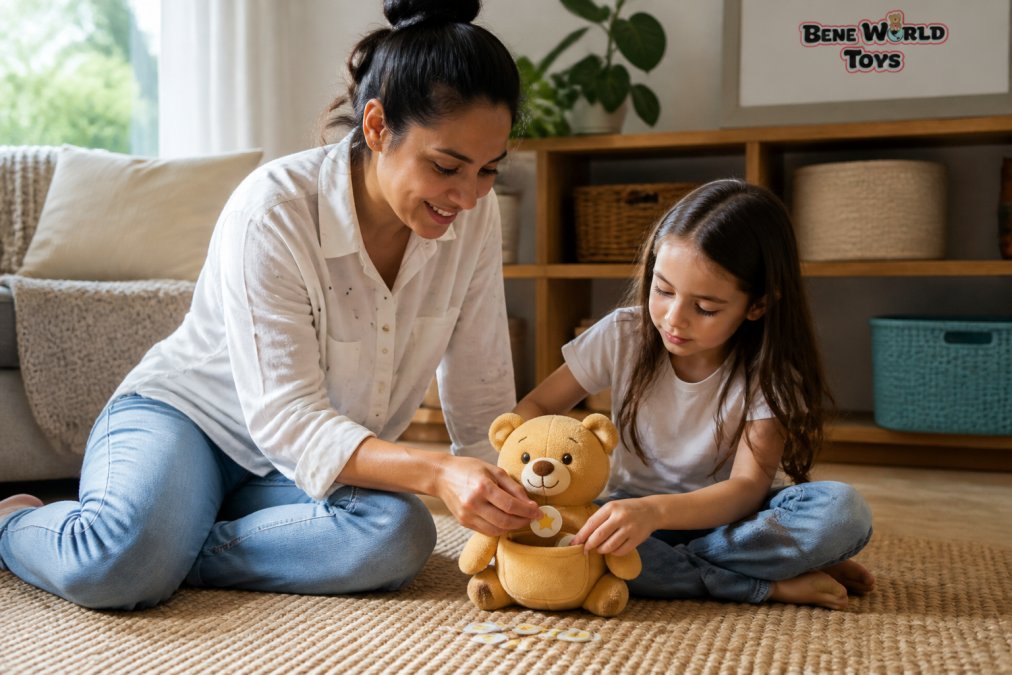
The distinction matters. On a sticker chart, the sticker is the reward. In a token system, the token is a placeholder, so the adult controls the value and can shift it as the child grows.
What Makes a Token System Stick
Three things separate a token system that lasts from one that fades:
- The token is physical and tactile, so the child can see progress accumulate
- The behavior is chosen by the parent to match what the family is actually working on
- The reward is set in advance and stays consistent, not renegotiated mid-week
Bene World Toys builds its kits around exactly this structure. Each kit pairs a plush character with a storybook and 15 reward tokens, and the parent chooses which behaviors earn a token. Bene Bear® covers respect, kindness, empathy, and giving, while Haylo the Horse focuses on calming and naming feelings.

The token count is fixed at 15, which gives a clear finish line without dragging on for months.
Building Intrinsic Motivation for Kids Through Connection
Intrinsic motivation for kids is the drive to do something because it feels good or matters to them, not because of an external payoff. It grows out of connection, not compliance. Children who feel securely connected to the adults around them are more willing to cooperate, and that willingness is the raw material intrinsic motivation is built from.
Natural and Logical Consequences as Teaching Tools
Natural consequences are what happen without adult intervention: a child who refuses a coat gets cold. Logical consequences are what an adult sets up as a reasonable result: a child who throws a toy has the toy put away for the rest of the afternoon.
Both teach more than a sticker ever will, because they connect the behavior to a real outcome rather than an arbitrary reward.
The catch is that consequences only work when delivered calmly. A consequence delivered in anger reads as punishment, and punishment invites resistance rather than reflection.
Age-Specific Alternatives to Sticker Charts
The right alternative depends heavily on the child's developmental stage. A system that works beautifully for a four-year-old will feel babyish to a seven-year-old, and pushing it anyway is one of the fastest ways to lose buy-in. The three bands below behave differently.
Ages 2-4: Concrete, Immediate, Physical
Preschoolers live in the present tense. A reward that arrives "on Friday" is functionally invisible to a three-year-old, and an abstract goal like "be respectful" has no meaning yet. What works is short, tangible, and repeatable.
- Token jars and pouches. A clear jar with five to ten tokens gives a child something to see fill up. The finish line should be reachable in a day or two, not a week.
- Plush characters with a pocket or pouch. The tactile act of dropping a token in is itself regulating for many toddlers, which is why a soft object often outperforms a glossy chart.
- First-then language. "First shoes, then outside" is a logical-consequence script that works before a child can negotiate. It is not a reward system at all, it is sequencing, and it holds up longer than stickers because there is nothing to run out of.
Pick one concrete behavior at a time: gentle hands, using words instead of grabbing, or putting shoes away. Two at once is one too many at this age.
Ages 5-8: Autonomy, Choice, and Experience Rewards
By five or six, most children want a say in the system.
Ages 9-12: Contribution, Not Compliance
What Changes Across All Three Bands
Neurodivergent-Friendly Approaches to Behavior Support
Why Standard Reward Systems Break for These Kids
Adjustments That Tend to Help
When to Drop the Reward System Entirely
Troubleshooting: When Your New System Stalls
Work through this in order:
| Problem | Likely Cause | Fix |
|---|---|---|
| Child stops caring about tokens | Reward no longer motivating | Let the child pick a new reward |
| Behavior improves then slides back | Feedback too slow | Reinforce immediately, not at day's end |
| Child argues about what counts | Target behavior too vague | Define one specific, observable behavior |
| Child loses interest entirely | No ownership in the system | Rebuild it together with the child |
Frequently Asked Questions
What can I use instead of a sticker chart?
Token-based reward systems, praise focused on effort, natural consequences, and collaborative problem solving are all effective alternatives. A token system works like a sticker chart but usually involves a physical object your child collects, which makes the progress more tangible. For example, Bene Bear® uses 15 reward tokens that a child earns for specific behaviors and redeems for a reward you choose. Pairing any system with genuine encouragement helps kids connect their actions to positive outcomes without relying on stickers alone.
Are sticker charts good for kids with ADHD or neurodivergent needs?
Sticker charts can work short-term for some children, but they often lose effectiveness for kids with ADHD because the reward is delayed and abstract. Neurodivergent children frequently respond better to immediate, tactile reinforcement. Token-based reward systems that involve holding and placing a physical token provide that instant feedback. Pairing tokens with clear, consistent language about the specific behavior being reinforced also helps. Many parents find that plush companions like Haylo the Horse make the routine feel comforting rather than pressuring.
How do I encourage positive behavior without relying on extrinsic rewards?
Focus on connection-based parenting and intrinsic motivation for kids. Describe what you notice ("You shared your toy with your sister, that was kind"), ask questions that build empathy, and let natural consequences teach when safe. Use extrinsic rewards sparingly and pair them with conversation about why the behavior matters. Token-based reward systems can serve as a bridge: the token marks the moment, but the real goal is helping your child feel proud of their choice. Over time, the internal reward of doing good becomes the driver.
What is the difference between extrinsic rewards and intrinsic motivation?
Extrinsic rewards come from outside the child, like stickers, tokens, or prizes. Intrinsic motivation comes from within, like feeling proud, capable, or connected to others. Sticker charts rely heavily on extrinsic rewards, which is why they often stop working once the novelty fades. Token-based reward systems can support intrinsic motivation when they are paired with specific praise and reflection. The goal is to use external tools temporarily while nurturing your child's internal sense of right and wrong, kindness, and self-discipline.