


Table of Contents
- Why Teaching Empathy Early Matters
- Step 1: Model Empathetic Behavior Daily
- Step 2: Build a Feelings Vocabulary
- Step 3: Use Empathy Activities for Toddlers
- Step 4: Read Books About Empathy for Toddlers
- Step 5: How to Teach Emotional Regulation to Toddlers
- Step 6: Guide Perspective-Taking in Real Moments
- Step 7: Reinforce Kindness with Specific Praise
- Frequently Asked Questions
Last Updated: September 6, 2026
Why Teaching Empathy Early Matters
Understanding how to teach empathy to toddlers is the process of helping children recognize, understand, and respond to the feelings of others, and it forms the foundation of emotional intelligence. When you teach empathy to toddlers during these formative years, you build the neural pathways for kindness and healthy relationships. Bene World Toys offers tools that make this learning tangible and repeatable.
Empathy is not an innate trait; it is a skill that develops through nurturing and practice. While toddlers are naturally egocentric, research confirms that even children under two can show early signs of prosocial behavior (peer-reviewed research). This guide covers seven practical, screen-free steps to build empathy building habits in your home.
Step 1: Model Empathetic Behavior Daily
Modeling is the most effective teaching strategy, because toddlers learn more from watching you than from anything you say. When you drop a glass and say, "Oh, I'm frustrated, I need to take a deep breath," you are demonstrating emotional regulation in real time.
Show empathy for everyone: the cashier having a slow day, the tired sibling, even the family pet. Narrate your response out loud: "That man looks sad, I think he misses his dog," or "Your sister is crying because she is tired, let's give her a quiet space." This verbal labeling connects internal states with outward behavior.
Step 2: Build a Feelings Vocabulary
Emotional literacy begins with naming the feeling, because children cannot regulate what they cannot identify. Before age three, most children default to "happy," "sad," or "mad (apa.org)." Expanding this vocabulary is a core part of how to teach empathy to toddlers effectively.
Attach emotion words to physical sensations: "frustrated" feels like a tight chest, "excited" feels like butterflies in the tummy. Use daily moments: "You are feeling disappointed that the park closed early." This validation teaches that all feelings are acceptable, even when certain behaviors are not.
Step 3: Use Empathy Activities for Toddlers
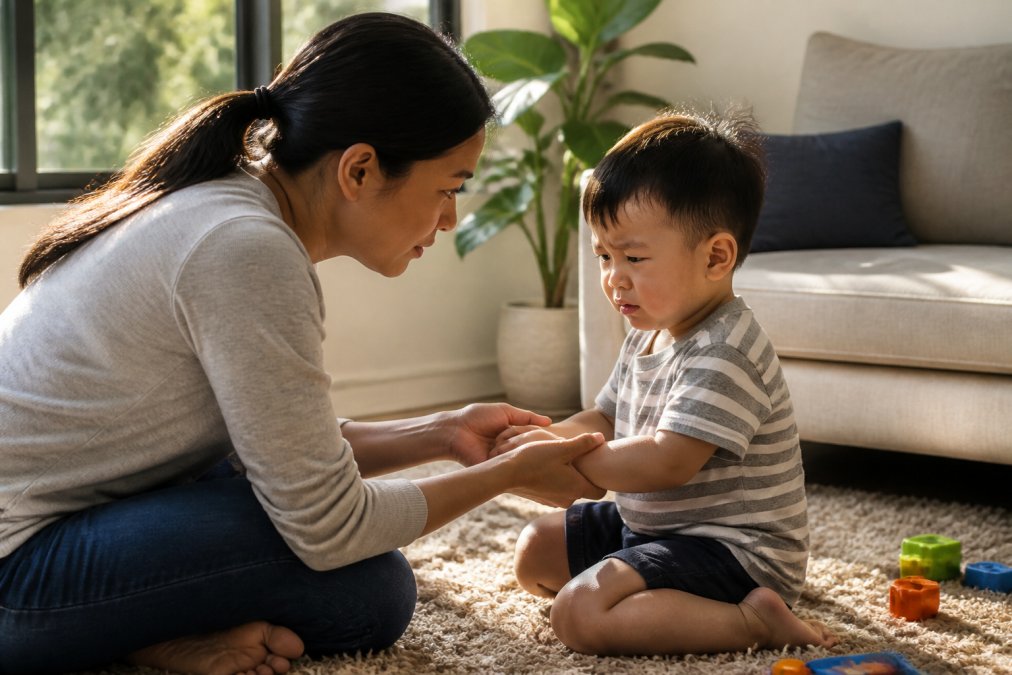
Structured empathy activities for toddlers turn abstract concepts into concrete, playful experiences. They engage multiple senses and allow practice in a low-stakes environment. The key is to move from simple recognition to active response, adapting to your child's temperament and stage.
Pretend Play Scenarios
Pretend play is a powerful vehicle for perspective-taking. When your toddler feeds a "hungry" doll or covers a "cold" teddy bear, they practice affective empathy. Extend the scenario: "How do you think the baby feels now that she has her bottle?"
Introduce a problem the toy cannot solve alone: "The bear is sad because he lost his favorite button. What can we do?" For a more advanced step, give two toys conflicting needs, one hungry, one tired, and ask your child to help both, forcing them to weigh competing perspectives.
Puppet and Plush Toy Conversations
Puppets and plush toys provide a safe emotional distance for exploring difficult feelings. A puppet can express being scared of the dark, allowing your child to respond with comfort without feeling threatened. This is effective for children reluctant to discuss their own emotions.
For an active child, keep puppet play physical: have the puppet "jump" with joy or "stomp" in frustration, and ask your child to mirror it. For a cautious child, keep the voice low and allow observation before participation. Do not force interaction; some toddlers need several sessions before engaging.
Emotion Charades with Real Faces
Play a modified charades game using only facial expressions. Make an exaggerated happy face, then sad, then surprised. Ask your child to name the emotion and copy it back. This builds the connection between recognizing and producing an emotion.
Once comfortable, reverse roles. When you guess incorrectly on purpose, your toddler corrects you, reinforcing that emotions are specific and observable. This requires no materials and works anywhere.
The Kindness Detective Game
Turn empathy into an observation game: "We are going to be kindness detectives today. We need to find three people being kind." Point out examples: "That boy shared his shovel at the sandbox." When you spot one, whisper, "Detective, we found one!" This trains your child to scan for prosocial behavior.
In reverse, when you see a child left out at the playground, ask, "What do you think that child is feeling? What clues do you see?" This builds the habit of reading body language and social context.
Adapting Activities for Neurodivergent Toddlers
Autistic or sensory-sensitive toddlers often experience empathy differently, they may feel others' distress intensely but struggle to show it in expected ways. The goal is not to force eye contact or verbal responses, but to build alternative communication pathways.
Use emotion cards with clear illustrations rather than real faces. Pair each with a physical sensation: "This face means 'frustrated.' It can feel like your whole body is tight." Practice in a quiet setting and allow pointing rather than speaking. For a child who scripts, have a puppet say "Are you okay?" and let your child repeat it, building a verbal script for real situations.
Step 4: Read Books About Empathy for Toddlers
Books about empathy for toddlers introduce characters whose feelings children can observe from a safe distance. Look for stories that explicitly name emotions and show characters working through social problems.
Pause to ask questions: "How do you think the bear feels right now?" or "What would you do if you were the rabbit?" This transforms passive listening into perspective-taking. Repeated readings let your child notice new emotional nuances and non-verbal cues.
Step 5: How to Teach Emotional Regulation to Toddlers
Teaching emotional regulation to toddlers is a prerequisite for empathy, because a child overwhelmed by their own feelings cannot attend to others'. It develops through co-regulation, where the adult provides the calm the child eventually internalizes.
During a meltdown, your first job is to provide safety and calm, not teach a lesson. Use a low voice: "I am here, you are safe, let's breathe together." Only after the storm passes can you help your child make sense of what happened.
A practical strategy is to create a "calm down corner" with sensory tools like soft pillows, a weighted blanket, or a feelings chart. The goal is not to punish the child with isolation, but to give them a designated space where they can practice self-regulation with your support nearby.
Step 6: Guide Perspective-Taking in Real Moments
The most authentic empathy lessons happen in daily life, when you help your toddler see another's point of view. Perspective-taking is the cognitive component of empathy and develops gradually throughout early childhood.
When a conflict occurs, resist saying "say sorry." Instead, guide your child toward understanding impact: "Look at Maya's face. How do you think she feels?" and "What could we do to help her feel better?" This turns discipline into an empathy building opportunity.
Sibling Conflict Scripts: The High-Intensity Scenario
Sibling conflicts are the hardest for perspective-taking, as your toddler is flooded with their own frustration. Use a structured three-phase script that separates the child from the behavior and focuses on repair.
Phase 1: Separate and Calm. Before perspective-taking, both children need to be regulated. Say, "I see two very upset children. We are going to take three breaths together before we talk." A toddler in a meltdown cannot access the part of their brain needed for perspective-taking.
Phase 2: Describe, Don't Accuse. Once calm, describe without blame: "I saw the red truck go from your brother's hands to yours. He started crying." Then ask, "What do you think his face looked like? Can you show me?" Mimicking the expression builds a stronger neural connection than a verbal answer.
Phase 3: Repair, Not Just Apology. Move beyond "sorry" to a repair action: "What could we do to help your brother feel better?" Offer options if stuck. This teaches that empathy requires action. For repeated offenses, involve the wronged sibling: "Your brother wants to help you feel better. What would help?"
Digital Empathy: A Modern Blind Spot
Toddlers today encounter emotions through screens daily, a grandparent on a video call, a character in a show. Digital empathy is the ability to respond to emotions transmitted through a screen, and it requires explicit teaching because the cues are different.
On a video call, narrate what you see: "Grandma looks tired today. Her voice is slower than usual. How do you think she is feeling?" This teaches that the person on the screen has real feelings affected by your child's actions.
When watching a show, pause and ask, "How do you know that character is sad? Is it his face, his voice, or his body?" For a struggling toddler, rewind and compare a happy face to a sad face from the same character, pointing out differences in the mouth and eyes.
Toddlers can be more impulsive on screens because the feedback loop is delayed. If your toddler says something unkind during a video call, treat it as seriously as an in-person comment: "I heard you say that to your cousin. Look at her face now. She heard you, and it hurt her feelings." Do not let the screen create a false sense of distance.
The Limits of Toddler Perspective-Taking
True perspective-taking does not fully develop until around age four to five (srcd.org). A two-year-old who hides behind a curtain because "if I can't see you, you can't see me" is demonstrating a normal developmental limitation. Focus on the observable, facial expressions, body language, vocal tone, rather than demanding a sophisticated theory of mind before the brain is ready.
Step 7: Reinforce Kindness with Specific Praise
Specific praise makes empathetic actions repeatable by telling the child exactly what they did well. Instead of "Good job!", try "I noticed you gave your brother the blue cup because you saw he wanted it. That was very kind and thoughtful."
This praise builds a child's identity as a kind person. Naming the specific behavior connects their action with a positive outcome for someone else. A token-based reward system makes "kindness" tangible and collectible.
A repeatable ritual helps your child internalize these values as part of who they are.
Teaching empathy to toddlers is not about perfection; it is about consistent, gentle practice. The journey requires patience, as toddlers will frequently regress. Bene World Toys supports this work with plush toys and storybooks that turn social-emotional learning into a daily habit. Our token-based reward system and magnetic tail connection provide tactile reinforcement, while the write-in pages encourage meaningful conversations. Get started with Bene World Toys and help your child develop character that will carry them through every stage of life.
Frequently Asked Questions
Is it normal for a 2-year-old to not show empathy?
Yes, it is completely normal. Empathy develops in stages, and most 2-year-olds are still in the egocentric phase, where they see the world only from their own perspective. They may notice when someone is upset, but they lack the cognitive skills to fully understand another person's feelings. You can start laying the groundwork by labeling emotions and modeling caring behavior, but expect consistent empathetic responses to emerge closer to age 3 or 4.
Can 3-year-olds understand empathy?
Yes, 3-year-olds begin to show early signs of empathy, though it looks different than in older children. They might offer a toy to a crying friend or say 'I'm sorry' after a push. This is the perfect time to teach empathy to toddlers through simple language like 'She feels sad because you took her block.' Keep explanations short and concrete, and reinforce the positive behavior you see with specific praise.
What causes lack of empathy in a child?
A lack of empathy in a child is rarely a fixed trait. It is usually a developmental gap tied to emotional regulation and perspective-taking skills, not a character flaw. A toddler who hits or grabs may be overwhelmed, tired, or simply unable to express their own needs. Instead of labeling the child as 'mean,' focus on teaching the missing skill: naming their own feelings first, then helping them notice the feelings of others.
What are the best empathy activities for toddlers?
The best empathy activities for toddlers are hands-on and play-based. Pretend play is a top choice, as it lets children practice taking on another role. Reading books about feelings and asking 'How do you think he feels?' builds perspective-taking. Using puppets or plush toys to act out scenarios like sharing or comforting a friend also works well. These activities teach empathy to toddlers without lectures, turning abstract ideas into concrete, repeatable lessons.