


Table of Contents
- Why Meaningful Gifts for Emotional Growth Matter
- How to Choose the Right Gift for Your Child's Needs
- Social Emotional Learning Toys That Build Connection
- Emotional Regulation Toys for Kids: Managing Big Feelings
- Kindness Activities for Kids Through Story and Play
- Gratitude Activities for Kids: Building Thankfulness Daily
- Interactive Games for Positive Behavior and Decision-Making
- What to Avoid When Gifting for Emotional Growth
- Frequently Asked Questions
Last Updated: October 11, 2026
Why Meaningful Gifts for Emotional Growth Matter
When you give a gift that builds character, you're not just handing over an object, you're creating a daily ritual that teaches your child to understand their emotions, practice kindness, and develop resilience.
At Bene World Toys, we've seen how the right gift transforms behavior without power struggles. A plush toy paired with a story and a simple reward system becomes a tool that reinforces positive choices day after day.
This matters now more than ever. Children today face real stress, transitions to new schools, social pressures, big feelings they don't have words for. A thoughtful gift acknowledges that struggle and gives them a concrete way to work through it.
How to Choose the Right Gift for Your Child's Needs
The most common mistake parents make is buying a gift based on what looks good or what's trendy, not what their specific child actually needs. Your child's age, personality, and current struggles should guide your choice.
Matching gifts to age and developmental stage
Children ages 3-5 benefit most from gifts that name emotions and build basic self-awareness. They're still learning to identify feelings, so a companion character that models emotional expression (like recognizing when someone is sad or angry) gives them language and permission to feel.
By ages 6-8, children can handle more complex social concepts. They start to understand friendship dynamics, peer pressure, and the difference between bravery and recklessness.
Considering sensory sensitivities and learning styles
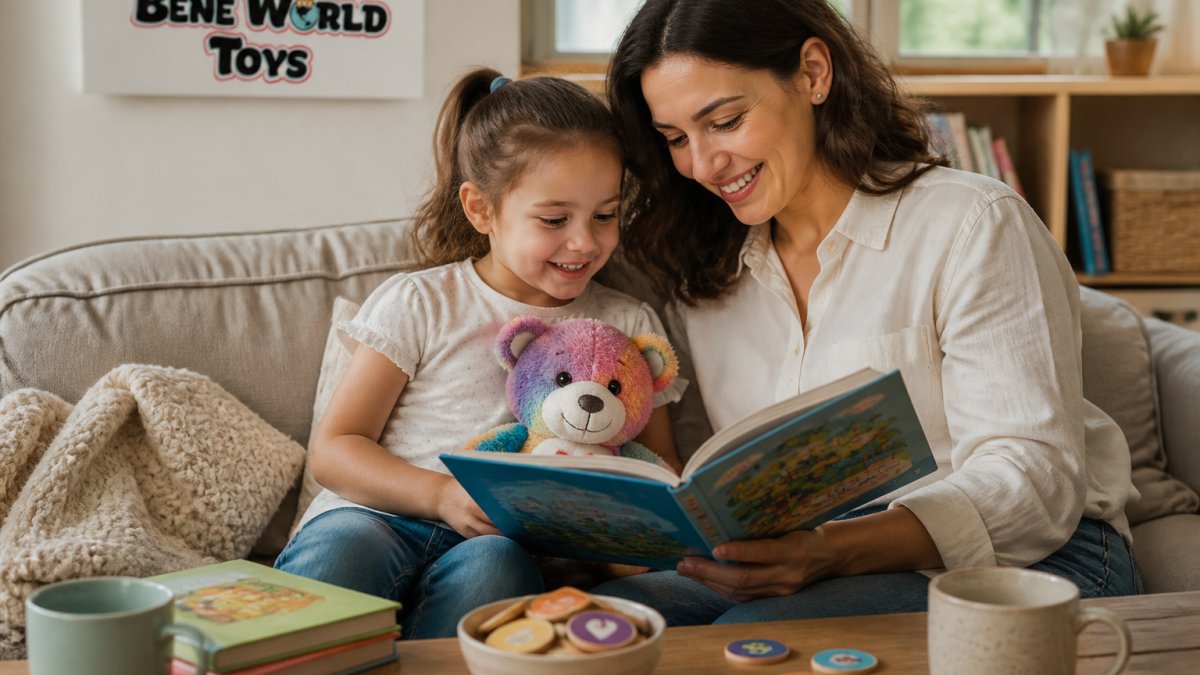
Some children are sensory-seeking; others are sensory-sensitive. If your child avoids textures or gets overwhelmed by stimulation, a soft plush with a calming routine works better than a flashy toy with sounds and lights. If your child craves tactile input, the magnetic tail connection and token system in many social-emotional kits provide exactly that kind of satisfying, repeatable feedback.
Also consider how your child learns best. Visual learners connect with bright illustrations and character stories. Kinesthetic learners thrive with the physical act of earning tokens and connecting magnetic pieces. Auditory learners benefit from reading the story aloud together.
Social Emotional Learning Toys That Build Connection
Social emotional learning toys teach children how to navigate relationships, recognize others' feelings, and practice kindness. These aren't passive toys, they're tools for building habits.
1. Bene Bear: The Kindness and Respect Builder
Bene Bear® is the flagship kit from Bene World Toys, designed to reinforce respect, kindness, empathy, and giving through daily routines. Your child earns tokens (up to 15) when they practice the behaviors you're focusing on, kind words, listening, helping, or gentle hands. When they collect all 15, they redeem a reward you set together.

What makes this different from a sticker chart: the storybook creates emotional context. Bene Bear isn't just a tracker; he's a character your child bonds with, which makes the behavior practice feel meaningful rather than transactional. The kit includes a storybook and reusable tokens, so you can run the system all year.
Best for: Families wanting a flexible, year-round system that adapts to whatever behaviors you're currently working on.
Price: $34.99
2. Sparkle the Rescue Dog: Teaching Empathy Through Care
Sparkle the Rescue Dog® centers on animal care and compassion. Your child earns tokens for kindness, helping, respectful words, and pet-care tasks. The angle here is different from Bene Bear, instead of general kindness, Sparkle channels your child's empathy toward caring for animals.
This kit resonates with animal-loving kids who need a reason to practice empathy. A portion of every Sparkle purchase supports animal rescue organizations, so your child learns that their choices ripple outward.
Best for: Children who love animals and respond well to purposeful giving.
Price: $34.99
3. Seawhee the Turtle: Building Responsibility and Compassion
Seawhee the Turtle teaches ocean conservation and environmental responsibility through story-led learning. The character helps kids fall in love with caring for the ocean by showing them concrete, kid-friendly actions they can take.
This kit works for curious children ages 4-8 who are drawn to nature and animals. It builds empathy not just for people, but for the world around them, a broader emotional skill that pays off as they grow.
Best for: Nature-curious kids and families wanting to build environmental awareness alongside emotional growth.
Price: $34.99
Emotional Regulation Toys for Kids: Managing Big Feelings
When a child's emotions escalate, they need a tool that helps them calm down and name what they're feeling. Emotional regulation toys do this without adding shame or pressure.
4. Haylo the Horse: A Companion for Emotional Support
Haylo the Horse is built specifically for big feelings, anger, sadness, anxiety, happiness. Unlike toys that distract from emotions, Haylo helps your child work through them.

This kit is designed for ages 3-6, especially sensitive or big-feelings kids. Haylo doesn't judge; he's a steady companion who helps your child understand that all emotions are okay, and that they can learn to express them safely.
The storybook shows a character dealing with rejection and shame, real situations kids face, and demonstrates how to move through those feelings. This is where emotional regulation becomes actionable rather than theoretical.
Best for: Sensitive children, kids prone to big emotional outbursts, and families wanting to reduce power struggles around feelings.
Price: $34.99
Kindness Activities for Kids Through Story and Play
Kindness isn't something you can lecture into a child. It has to be practiced, celebrated, and woven into daily routines. Story-led kits make that practice feel like play.
5. Friendship Tails: Pyro & Uniglo
Pyro the dragon and Uniglo the unicorn teach friendship skills, kind words, inclusion, taking turns. When your child shows friendship, they connect the magnetic tails together, creating a "friendship moment" ritual.
Friendship Tails Kit: Pyro & Uniglo →
The write-in pages help your child remember names and relationships, turning friendship into something concrete rather than abstract. This kit is perfect for kids heading into preschool or early elementary who need confidence in social situations.
Best for: Children starting new social environments or struggling with peer relationships.
Price: $24.99
6. Brave Tails: Gracey and Louey
Gracey the elephant and Louey the lion teach what bravery actually looks like: doing hard things while you're scared. This reframes courage for kids who think bravery means not being afraid.
The storybook walks through real situations, trying again after failure, speaking up, navigating new situations. When your child shows courage, they wrap the magnetic tails together. It's a simple, powerful "I did it" moment that builds confidence over time.
Best for: Anxious children, kids facing transitions, and families wanting to build resilience.
Price: $24.99
Gratitude Activities for Kids: Building Thankfulness Daily
Gratitude doesn't come naturally to children, it's a skill that requires practice and modeling. When you build it into a daily routine with the right tool, it sticks.
7. Thankful Tails: Nash and Frankie
Nash the cat and Frankie the dog help kids notice the good stuff and talk about it every day. The kit makes gratitude concrete with relatable examples kids understand, and the built-in pages create space for meaningful conversations between you and your child.
Use this at bedtime, after school, or during tough moments. The magnetic tail connection lets kids carry Nash and Frankie along, making gratitude portable.
Best for: Families wanting to build a daily gratitude habit without it feeling forced or preachy.
Price: $24.99
Interactive Games for Positive Behavior and Decision-Making
Games teach decision-making in a low-pressure way. When your child plays, they're practicing real-world choices in a safe, fun context.
8. What Would You Do? Situational Card Game
This card game includes 60 situational cards that present everyday scenarios. Your child chooses the answer that shows positive behavior and earns a point. If they choose negative behavior, they earn zero points.
The game works because it makes abstract concepts concrete. Instead of telling your child "be kind," the game shows a specific situation (someone is left out at recess) and lets your child practice the right choice. Playing repeatedly builds decision-making muscle memory.
Best for: Families wanting a fun, interactive way to practice social-emotional skills, and classrooms reinforcing positive behavior.
Price: $7.99
| Gift | Age Range | Focus | Price | Best For |
|---|---|---|---|---|
| Bene Bear® | 3-8 | Kindness, respect, empathy, giving | $34.99 | Flexible year-round system |
| Sparkle the Rescue Dog® | 3-8 | Animal care, compassion | $34.99 | Animal-loving kids |
| Seawhee the Turtle | 4-8 | Ocean care, responsibility | $34.99 | Nature-curious kids |
| Haylo the Horse | 3-6 | Emotional regulation, naming feelings | $34.99 | Big-feelings kids |
| Friendship Tails | 3-8 | Friendship skills, inclusion | $24.99 | Social confidence building |
| Brave Tails | 3-8 | Courage, resilience | $24.99 | Anxious or transitioning kids |
| Thankful Tails | 3-8 | Gratitude, daily habits | $24.99 | Building thankfulness |
| What Would You Do? | 4-8 | Decision-making, choices | $7.99 | Interactive learning |
What to Avoid When Gifting for Emotional Growth
Not every well-intentioned gift lands. Here's what to skip.

Don't buy a gift just because it looks cute or educational if it doesn't match your child's actual needs right now. A gratitude kit won't help a child drowning in anxiety.
Avoid gifts that feel like punishment or pressure. If your child senses the gift is really a tool to "fix" them, they'll resist it.
Skip gifts that require constant adult management. The best emotional growth tools work because your child can engage with them independently, with you as a guide.
Don't expect instant behavior change. These tools work over weeks and months, not days. The reward system builds gradually, and the character connection deepens with repeated story readings and play.
Emotional growth doesn't happen through lectures or punishment. Start with whichever kit matches your child's biggest need right now, and watch how a small daily ritual builds real, lasting change. Shop now and give your child a gift that grows with them.
Frequently Asked Questions
What are meaningful gifts for emotional growth that actually work?
Meaningful gifts for emotional growth combine story, tactile play, and reinforcement systems. Kits like Bene Bear and Haylo the Horse use token-based rewards to make positive behaviors repeatable. The key is choosing gifts that create rituals around the skill you want to build, whether that's kindness, emotional regulation, or gratitude. These work best when paired with consistent use and parent-child connection.
How can social emotional learning toys help my child?
Social emotional learning toys teach children to recognize and manage emotions, practice kindness, and build confidence through guided play. Unlike passive toys, these kits include stories that model behaviors, plush companions kids bond with, and reward systems that reinforce practice.
What's the difference between a reward chart and emotional regulation toys for kids?
A reward chart is visual tracking. Emotional regulation toys for kids go deeper: they combine comfort (the plush), narrative (the story), and tactile reinforcement (magnetic tails or tokens). This multi-sensory approach helps children internalize the skill, not just chase points. Haylo the Horse, for example, becomes a daily emotional support companion, not just a tracking tool.
Can gratitude activities for kids really build a lasting habit?
Yes, when gratitude activities for kids are tied to consistent rituals and tangible reinforcement. Kits like Thankful Tails work because they make gratitude concrete with write-in pages, plush companions, and magnetic tail connections. Used daily at bedtime or after school, these rituals help children notice good moments and talk about them, skills that stick over time.
Are these gifts suitable for children with sensory sensitivities or autism?
Many are, but match the specific child. Haylo the Horse is designed for sensitive kids and big-feelings children ages 3-6. The plush textures, gentle stories, and low-pressure token system work well for children who struggle with traditional reward charts. Always consider your child's sensory preferences and choose gifts with soft, quality materials. Some children benefit from the structure; others may find the routine overwhelming, know your child first.