


Table of Contents
- Quick Comparison: 5 Emotional Regulation Plush Toys
- Why Sensory Friendly Plush Toys Work for Emotional Regulation
- 1. Haylo the Horse: Best for Big Feelings and Daily Calming
- 2. Brave Tails: Gracey and Louey: Best for Building Courage
- 3. Thankful Tails: Nash and Frankie: Best for Gratitude and Connection
- 4. Bene Bear®: Best All-Around Kit for Positive Behavior
- 5. The My Reward Pal™ Collection: Best Value Bundle
- The Benefits of Plush Toys for Autism and Sensory Processing
- Frequently Asked Questions
Last Updated: September 27, 2026
Quick Comparison: 5 Emotional Regulation Plush Toys
Sensory friendly emotional regulation plush toys give children a physical way to manage big feelings. At Bene World Toys, we design plush companions that turn calming strategies into a daily habit. This guide compares five options to match a toy to your child's needs. Integrating these tactile tools into a broader routine often complements the use of sensory-friendly clothing options that minimize physical discomfort throughout the day.
Quick Picks:
- Best for big feelings: Haylo the Horse, $34.99
- Best for building courage: Brave Tails: Gracey and Louey, $24.99
- Best for gratitude and connection: Thankful Tails: Nash and Frankie, $24.99
- Best all-around kit: Bene Bear® Kit, $34.99
- Best value bundle: The My Reward Pal™ Collection, $124.99
| Product | Price | Best For | Ages |
|---|---|---|---|
| Haylo the Horse | $34.99 | Big feelings, daily calming | 3-6 |
| Brave Tails: Gracey and Louey | $24.99 | Building courage | 3-8 |
| Thankful Tails: Nash and Frankie | $24.99 | Gratitude and connection | 3-8 |
| Bene Bear® Kit | $34.99 | Positive behavior | 3-8 |
| The My Reward Pal™ Collection | $124.99 | Complete value bundle | 3-8 |
Child Mind Institute guide to helping children manage emotions

Why Sensory Friendly Plush Toys Work for Emotional Regulation
A plush toy works for emotional regulation because it combines tactile comfort with a repeatable routine. When a child hugs something soft during a hard moment, the body gets a signal that it is safe. Pair that with a simple practice, like earning a token for calming down, and comfort becomes a skill.
Deep Pressure Stimulation and Proprioceptive Input
Deep pressure stimulation is the calming effect of firm, even touch, like a strong hug or weighted blanket. Proprioceptive input is the body's sense of where it is in space, activated by pushing, pulling, and squeezing. Both help regulate the nervous system.
American Occupational Therapy Association on sensory integration
1. Haylo the Horse: Best for Big Feelings and Daily Calming
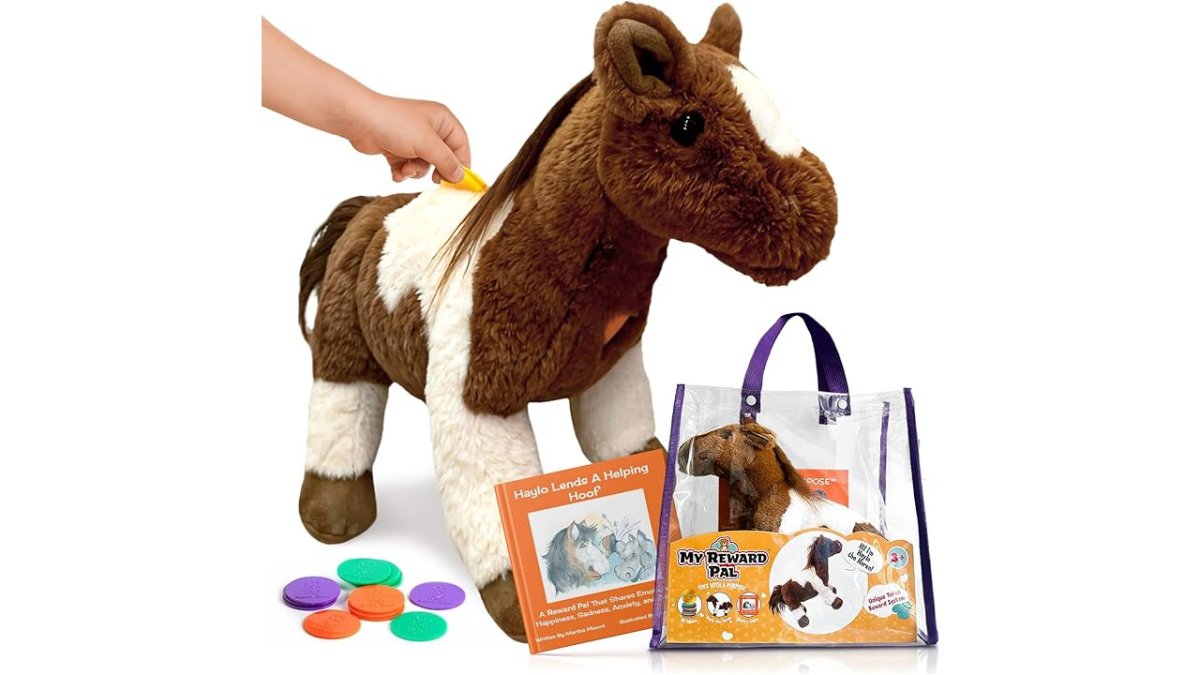
Haylo the Horse is our top pick for children who melt down fast and need help settling. Priced at $34.99, Haylo is built for ages 3-6, especially sensitive kids with big feelings.
2. Brave Tails: Gracey and Louey: Best for Building Courage
Brave Tails reframes what bravery means. The kit pairs Gracey the elephant and Louey the lion with a story teaching one truth: bravery is doing hard things while scared. It sells for $24.99.
3. Thankful Tails: Nash and Frankie: Best for Gratitude and Connection
Gratitude is abstract for young kids. Thankful Tails makes it concrete. The kit includes Nash the cat and Frankie the dog plus a story showing what thankfulness looks like in everyday moments. It costs $24.99.
4. Bene Bear®: Best All-Around Kit for Positive Behavior
Bene Bear® is the "good choices" kit and the most flexible option in this lineup at $34.99. It targets four behaviors: respect, kindness, empathy, and giving.
5. The My Reward Pal™ Collection: Best Value Bundle
If you want the whole set, The My Reward Pal™ Collection bundles all four kits for $124.99. It includes Bene Bear®, Sparkle the Rescue Dog™, Seawhee the Turtle, and Haylo the Horse.

Cleaning and Maintaining Sensory Plush Without Ruining Them
A plush that a child presses to their face, chews, and drags across the floor gets dirty fast. A child sensitive to smells or textures will notice a stale toy before you do, and a toy out of commission during a hard week stops working.
- Check the care tag first. Every kit ships with its own instructions, and those instructions override any general advice here. If the tag says surface clean only, do not put it in a machine.
- Spot clean the common way. For most plush, a mild soap and a damp cloth work for everyday grime. Blot, do not scrub, and let it air dry fully before it goes back in rotation. Damp stuffing is what causes mildew, and mildew is what causes the smell a sensitive child will reject.
- Handle weighted toys with care. A weighted plush holds its shape because of the filler inside, and a hot dryer or a heavy wash cycle can shift that filler into a lump. If the tag allows machine washing, use cold water on a gentle cycle and air dry. Never wring a weighted toy out.
- Protect the interactive parts. Magnetic tails, token pouches, and any sewn-in plastic piece are the first things to fail in a wash. For those kits, spot clean the fabric and wipe the hard parts with a damp cloth. Keep magnets away from heat, which can weaken them over time.
- Keep a backup in rotation. This is the single most useful habit. If one toy is drying or being cleaned, a second one keeps the routine intact. A child who relies on the same calming sequence does not do well when the tool disappears for two days.
- Air it out weekly. Even a clean toy picks up household smells. A few hours in open air, out of direct sun, keeps it fresh between deeper cleans.
The Benefits of Plush Toys for Autism and Sensory Processing
The benefits of plush toys for autism and sensory processing come down to predictability and control. A child on the autism spectrum often feels overwhelmed by unpredictable input: loud rooms, sudden changes, unfamiliar textures. A plush companion offers the opposite. It feels the same every time, and the child decides when to reach for it.
Matching the Toy to Your Child's Sensory Profile
Choosing the right sensory toy for autism means matching the toy to the child's sensory profile, not age alone. Most practitioners group kids into a few broad patterns, and the right plush looks different for each.
- Deep-pressure seekers. These kids crash into furniture, hug hard, and lean on people. They respond to firm, even weight rather than a light cuddle. A weighted stuffed animal, or a plush with a firm body and a heavy base, gives them the input they are already chasing. Look for even weight distribution so the toy does not slump to one side.
- Tactile seekers. These kids rub fabric, chew sleeves, and touch everything in reach. They do well with a toy that has a tactile action built in, like a magnetic tail that clicks together, a crinkly panel, or a textured patch. The action gives their hands a job during a hard moment.
- Tactile avoiders. These kids flinch at seams, tags, and scratchy fabric. For them, softness and a smooth surface matter more than weight. A light, single-fabric plush with no hard parts and no exposed tags is the safer pick. Test the toy against the inside of their wrist before you commit.
- Movement seekers. A child who craves motion may ignore a passive stuffed animal. They respond better to a toy tied to a routine they can act out, like connecting two tails or placing a token in a pouch, because the motion is part of the calming sequence.
Why the Routine Matters as Much as the Texture
The texture gets a child's attention. The routine builds the skill. When the same calming sequence happens every time, the toy becomes a predictable cue the child can eventually use without an adult. That is the shift from co-regulation, where you calm them, to self-regulation, where they calm themselves.
CDC on supporting children's social and emotional development
Frequently Asked Questions
Can any stuffed animal be an emotional support stuffed animal?
Any plush can offer comfort, but emotional regulation plush toys are designed with specific features that make them more effective. Look for toys with tactile elements like magnetic tails, token pouches, or weighted inserts that provide predictable sensory input. Bene World Toys' kits pair plush companions with storybooks and reward tokens, turning comfort into a repeatable routine. The structured system helps children connect the toy to calming strategies, which a standard stuffed animal cannot do on its own.
What kinds of sensory toys can help children with emotional regulation?
Toys that provide deep pressure stimulation, proprioceptive input, or tactile comfort work well for emotional regulation. Weighted plush toys, magnetic connection kits, and textured stuffed animals give children a physical anchor during sensory overload. Bene World Toys' Haylo the Horse uses a token pouch system that reinforces calming behaviors. Brave Tails adds magnetic tails kids can connect as a tactile 'I did it' moment. These features support nervous system regulation through predictable, hands-on play.
How do the benefits of plush toys for autism support sensory processing?
Plush toys offer predictable tactile input, which helps children on the autism spectrum manage sensory processing challenges. The soft texture provides calming sensory feedback, while structured routines around the toy build emotional literacy. Bene World Toys' kits include storybooks that give kids language for big feelings and token systems that make positive behavior repeatable. For autistic children, this combination of tactile comfort and clear expectations reduces anxiety and supports self-regulation during transitions or overwhelming moments.
How do I clean and maintain sensory plush toys?
Most sensory plush toys can be spot-cleaned with a damp cloth and mild soap, then air-dried. For deeper cleaning, check the care label; many are surface-wash only to protect magnetic components or weighted inserts. Bene World Toys' plush companions feature magnetic tails, so avoid submerging them in water. Wipe tokens with a disinfecting wipe between uses, especially in classroom settings. Regular cleaning keeps fabrics fresh and extends the life of the toy.
Can printable social emotional learning activities be used alongside plush toys?
Yes, printable social emotional learning activities pair well with plush toys to reinforce emotional regulation skills. Use worksheets for feeling identification, gratitude prompts, or breathing exercises, then have your child practice the skill with their plush companion. Bene World Toys' kits include write-in pages that serve a similar purpose. Combining printable activities with a tactile plush routine creates consistency between home and classroom, helping children generalize calming strategies across different settings.
Big feelings do not have to end in a power struggle. Bene World Toys builds plush companions and storybooks that turn calming, courage, and gratitude into daily habits kids can repeat. With a token-based reward system, magnetic tail connections, and write-in pages for parent-child connection, each kit gives you a gentle script for the hardest moments. Get started with Bene World Toys and give your child a calming tool they control.