


Table of Contents
- What Makes a Strong Slumberkins Alternative for Emotional Learning
- Social Emotional Learning Toys for Toddlers: What Works at Ages 3-5
- How to Teach Empathy to Preschoolers With Plush Companions and Stories
- Printable Social Emotional Learning Activities to Pair With Plush Toys
- Comparing Emotional Learning Kits: Plush Toys, Storybooks, and Token Systems
- Choosing the Right Slumberkins Alternative for Your Child's Needs
- Frequently Asked Questions
Last Updated: September 20, 2026
What Makes a Strong Slumberkins Alternative for Emotional Learning
Finding a Slumberkins alternative for emotional learning comes down to one question: does the tool change behavior, or just look good on a shelf? Bene World Toys builds kits around a token system, where children earn tangible rewards for practicing skills like naming feelings, calming down, and showing kindness. That hands-on loop separates a working tool from a cute plush.
Key Features to Look For in Emotional Learning Toys
Look for these features before you buy:
- A named character with a story. Children attach to personalities, not concepts. A plush with a backstory gives them someone to talk to about big feelings.
- A tactile reinforcement action. Connecting magnetic tails, dropping a token in a pouch, or wrapping two plush friends together gives the child a physical "I did it" moment.
- A tracking system that stays visible. Tokens kept inside the plush stay in the child's world. Charts on walls fade into the background.
- Write-in or conversation pages. Adults need prompts too. Pages that ask parent and child to record a moment together turn the toy into a shared ritual.
- Age-appropriate language. A kit for a 3-year-old should not read like a workbook for a 7-year-old.
- Open-ended behavior goals. The best kits let you choose which behavior to reinforce this week, so the tool grows with your child.
For a practical starting point, the American Academy of Pediatrics guidance on social-emotional development outlines how emotional skills build in layers from ages 3 to 8, which is useful context when matching a tool to your child's stage.
Social Emotional Learning Toys for Toddlers: What Works at Ages 3-5
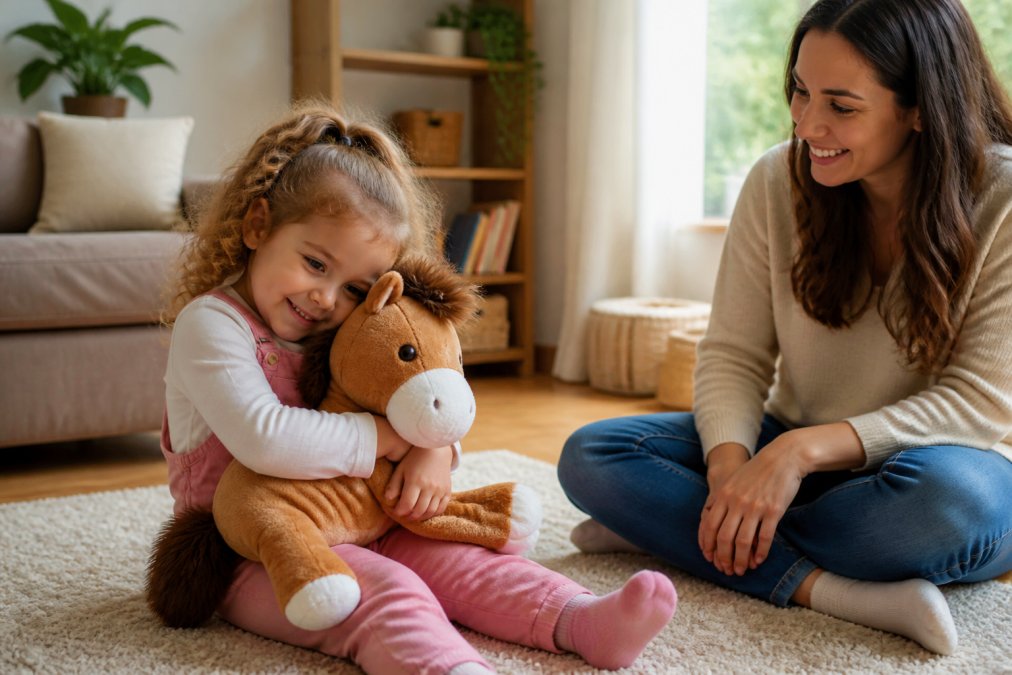
Social emotional learning toys for toddlers work best when they match the child's developmental stage, not just chronological age. At ages 3 to 5, children are in the "emotional labeling" phase: they can identify basic feelings like happy, sad, and mad, but need concrete, physical ways to practice regulating them. A toy for a 3-year-old learning to name frustration won't work for a 5-year-old ready for perspective-taking.
Ages 3-4: Naming and Tolerating Big Feelings
At this stage, the goal is simple: help the child notice a feeling and do one small action instead of melting down. Haylo the Horse ($34.99) is designed for ages 3-6, with a token pouch a child can drop a token into each time they practice calming down or naming a feeling. Repeated, that action teaches the child emotions can be worked through rather than exploded.

Ages 4-5: Empathy and Social Awareness
Ages 4 to 5 is when children start noticing others' feelings and understanding different perspectives, the right time to introduce a character who models care. Seawhee the Turtle ($34.99), for curious kids ages 4 to 8 who love animals and nature, uses its story and write-in pages to prompt children to think about how a turtle feels when its habitat is threatened, then connect that to how a friend feels when left out.
What to Avoid at This Age
Avoid toys that rely on verbal instruction alone or require reading, and reward systems with fixed, competitive scoring, a 4-year-old who loses points may shut down rather than practice. The best tools are open-ended, repeatable, and forgiving.
How to Teach Empathy to Preschoolers With Plush Companions and Stories
Brave Tails with Gracey and Louey ($24.99) covers a related skill: courage. Gracey the elephant and Louey the lion teach that bravery is doing hard things while scared, not the absence of fear. Connecting their tails becomes a "brave moment" ritual for speaking up, trying again, or facing a new situation.
Printable Social Emotional Learning Activities to Pair With Plush Toys
Printable social emotional learning activities extend a plush kit's value beyond the toy, giving children something to do with their hands while the conversation happens, keeping attention on the feeling rather than on sitting still.
Try these pairings:
- Feelings check-in cards. Print simple faces and have the child point to how they feel, then tell their plush about it.
- Gratitude prompts. A short daily prompt pairs naturally with Thankful Tails featuring Nash and Frankie ($24.99), which centers on noticing good things and talking about them.
- Kindness challenges. A weekly card with one small kind act to complete pairs with Bene Bear® ($34.99), which reinforces respect, kindness, empathy, and giving.
- Brave moment logs. A simple page where the child draws or writes one brave thing they did that day.
Comparing Emotional Learning Kits: Plush Toys, Storybooks, and Token Systems
Emotional learning kits fall into three broad formats, and each one suits a different child and family. Plush-plus-token systems build daily habits. Storybooks build language and understanding. Standalone token systems work best for children who already have the vocabulary and just need the structure.
| Kit Type | Example | Best For | Price |
|---|---|---|---|
| Plush + token system | Haylo the Horse | Big-feelings kids, ages 3-6 | $34.99 |
| Plush pair + magnetic ritual | Friendship, Brave, Thankful Tails | Friendship, courage, or gratitude focus | $24.99 |
| Character kit + 15 tokens | Bene Bear® | General character building, ages 4-8 | $34.99 |
| Storybook only | Bene Bear® Benefits The World | Families who already own a plush | $6.99 |
| Card game | What Would You Do? | Groups, classrooms, siblings | $7.99 |
| Full bundle | Bene Tails Bundle | Families wanting all three Tails kits | $68.99 |
Choosing the Right Slumberkins Alternative for Your Child's Needs
Choose based on the skill your child struggles with, not which plush looks cutest. A child who melts down at transitions needs a different tool than one who struggles to share. Beyond surface behavior, the best choice depends on how your child processes sensory input, language, and social cues. This framework accounts for neurodivergent needs, a gap most competitors ignore.

Step 1: Identify the Core Emotional Skill Gap
Start by observing the pattern. Does your child struggle most with:
- Big emotions and meltdowns: Haylo the Horse, built for ages 3 to 6 and sensitive kids. The token pouch provides a physical outlet for calming.
- Friendship and social confidence: Friendship Tails with Pyro and Uniglo. The magnetic tail connection ritual reinforces turn-taking and kind words.
- Anxiety and new situations: Brave Tails with Gracey and Louey. The story frames bravery as doing hard things while scared, not the absence of fear.
- Gratitude and perspective: Thankful Tails with Nash and Frankie. The daily prompt encourages noticing good things.
- General character and classroom use: Bene Bear® or Sparkle the Rescue Dog®, which the brand notes works well in classroom settings.
- Empathy for animals and nature: Seawhee the Turtle, aimed at ages 4 to 8.
Step 2: Consider Sensory and Processing Needs
For parents of neurodivergent children, whether diagnosed with autism spectrum disorder, ADHD, or sensory processing differences, a token system's structure can be a genuine advantage. A child who struggles with verbal instructions often responds to a physical token they can hold. The tactile element, whether a magnetic tail or a token dropped into a pouch, gives clear feedback without relying on language alone.

Step 3: Match the Format to Your Family's Routine
Emotional learning kits fall into three broad formats, and each one suits a different child and family. Plush-plus-token systems build daily habits. Storybooks build language and understanding. Standalone token systems work best for children who already have the vocabulary and just need the structure. If your family is often on the go, a compact card game like What Would You Do? ($7.99) may be more practical than a plush that stays at home.
Step 4: Plan for Generalization
The final step is ensuring the skill transfers beyond the toy. Grandparents seeking a meaningful gift should note these kits include a storybook and built-in routine, the recipient gets an activity, not just an object. To generalize, use the same language and rituals in different settings: the car, the grocery store, the playground. The plush becomes a portable anchor for the skill.
Frequently Asked Questions
What are some good toys for emotional development?
Toys that combine a comfort object with a repeatable routine tend to work best. Plush companions paired with storybooks give children a character to bond with and a narrative that names feelings. Token-based reward systems add a hands-on element: when a child practices calming down or using kind words, they place a token in the plush toy's pouch. This turns emotional regulation into something tangible. Look for kits that include write-in pages so adults and children can reflect together. Options like Haylo the Horse ($34.99) and Bene Bear ($34.99) follow this model and are designed for ages 3-6.
Do emotional learning plush toys actually help with anxiety?
Plush toys alone do not treat anxiety, but they can support emotional regulation when paired with consistent adult guidance. The tactile comfort of a soft toy gives children a physical anchor during stressful moments. When a plush companion is tied to a routine, such as naming a feeling and placing a token in the pouch, children build emotional awareness over time. Haylo the Horse is specifically designed for big-feelings kids ages 3-6 and includes a token system that reinforces calming and expressing emotions without pressure. Consistency matters more than the toy itself.
Are there affordable alternatives to premium emotional learning kits?
Yes. Some emotional learning kits cost $50 or more, but several options come in under $35. Bene World Toys offers Haylo the Horse at $34.99 and Bene Bear at $34.99, both of which include a storybook and 15 reward tokens. The Bene Tails Bundle, which includes three plush pairs covering friendship, bravery, and gratitude, is $68.99. For a lower entry point, the What Would You Do? Situational Card Game is $7.99 and covers 60 scenarios for positive behavior. You can also pair a single plush kit with free printable activities to extend the learning without adding cost.
How do token-based reward systems support emotional regulation?
Token systems make abstract concepts like kindness or patience concrete. When a child earns a token for a specific behavior, such as using calm words instead of yelling, they see immediate feedback. Over time, the repeated action builds a habit. Bene Bear uses 15 tokens that children collect before redeeming a reward the parent sets. Haylo the Horse uses a pouch on the plush toy where children place tokens after practicing calming strategies. This approach reduces power struggles because the focus shifts from punishment to positive reinforcement, and the child participates actively in tracking their own progress.
What age range is most appropriate for emotional learning plush toys?
Most emotional learning plush kits are designed for ages 3-8. Haylo the Horse is best for ages 3-6, especially children who experience big feelings. Seawhee the Turtle targets ages 4-8 for kids who love animals and nature. Bene Bear and Sparkle the Rescue Dog work well across the full 3-8 range because the token system is flexible. For toddlers under 3, simpler plush toys without small tokens are safer. If your child is 8 or older, they may still engage with the storybook and plush, but the token system may feel too young. Matching the kit to your child's developmental stage matters more than the brand.