


Last Updated: October 25, 2026
Quick Summary
ADHD emotional regulation is the brain's ability to manage the timing, size, and recovery of an emotional response, and in ADHD that system runs on a different schedule. Feelings arrive faster and louder and take longer to settle because the brain systems handling executive function, which act as a brake on emotional response, engage slowly. A child with ADHD isn't choosing to overreact; their regulation circuitry is doing what it's wired to do, just on a delay.
- Signs of emotional dysregulation cluster around four dimensions: intensity, speed, recovery, and frequency.
- Track how often episodes happen, their intensity on a 1-5 scale, and recovery time for two weeks.
- Teach calm-down skills during calm moments, not during a meltdown, since a stressed child cannot learn.
- Mid-outburst, reduce pressure rather than teach a lesson, and save correction for after recovery.
- Seek help when outbursts cause injury or meltdowns last longer than thirty minutes most days.
Table of Contents
- How ADHD Emotional Regulation Works in the Brain
- Signs of Emotional Dysregulation in Children
- Why ADHD Meltdowns in Children Hit So Hard
- Emotional Regulation Strategies for Children with ADHD
- Calming Techniques for Children with ADHD During a Storm
- How to Support a Child Mid-Outburst Without Escalating
- When to Seek Professional Help for ADHD Emotional Regulation
- Build a Daily Regulation Routine with Bene World Toys
- Frequently Asked Questions
How ADHD Emotional Regulation Works in the Brain
Here's what's happening underneath. ADHD affects the brain systems that handle executive function: the set of mental skills that include attention, impulse control, and self-control.
So a child with ADHD isn't choosing to overreact. Their emotional regulation circuitry is doing exactly what it's wired to do, just on a delay.
Emotional dysregulation is the pattern that results: intense emotions, rapid mood shifts, and a recovery time that outlasts the trigger.
If you want the broader playbook for teaching these skills at home, our guide on how to teach kids emotional regulation walks through the full sequence.
Signs of Emotional Dysregulation in Children
Signs of emotional dysregulation in children cluster around four dimensions: intensity, speed, recovery, and frequency. Watch for outbursts that seem out of proportion to the trigger, mood swings that flip in seconds, and a child who stays upset long after the moment has passed. What separates ADHD-related dysregulation from ordinary childhood big feelings is the pattern, not any single episode.
The most common signs families report:
- Intense emotional reactions to small problems, like a wrong cup or a lost turn
- Rapid mood shifts from happy to furious with no visible warning
- Difficulty calming down once upset, even with help
One sign parents often miss: a child who seems fine but is quietly exhausted after school. That flat, worn-out look can be the aftermath of holding it together all day, and it is often the most reliable clue that regulation demands are outpacing capacity.
How the signs differ by age
The same underlying dysregulation looks different at different stages, which is why a single checklist rarely fits.
- Preschool (ages 3-5): meltdowns over transitions, hitting or biting when frustrated, difficulty waiting even briefly, and crying that escalates rather than winds down with comfort.
- School age (ages 6-12): outbursts at home after a masked day at school, tears over homework, slammed doors, and friendship friction from interrupting or reacting too fast.
- Adolescents (ages 13-18): irritability, withdrawal, explosive arguments over small requests, risk-taking when upset, and shame after an episode that can look like depression.
What makes it ADHD-related rather than something else
Emotional dysregulation is not a formal diagnostic criterion in the DSM-5-TR the way inattention and hyperactivity are, so clinicians look for it as a pattern that co-occurs with core ADHD symptoms rather than as a standalone diagnosis.
A useful rule of thumb practitioners use: if the big reactions consistently follow fatigue, hunger, transitions, or sensory overload, and the child recovers slowly even with support, ADHD-related regulation differences are worth discussing with a clinician.
A simple way to tell whether it is a problem
Track three things for two weeks: how often episodes happen, how intense they are on a simple 1-5 scale, and how long recovery takes. A pattern of episodes most days, intensity at 4 or 5, or recovery longer than 30 minutes is the kind of data a pediatrician or therapist can actually use. It also gives you a baseline to measure progress against, which is far more useful than trying to remember how last month went.
The article groups the most commonly reported signs of emotional dysregulation in children under four dimensions.
| Dimension | What to watch for |
|---|---|
| Intensity | Outbursts out of proportion to the trigger |
| Speed | Mood swings that flip in seconds |
| Recovery | Child stays upset long after the moment passed |
| Frequency | A pattern of episodes, not a single episode |
Why ADHD Meltdowns in Children Hit So Hard
ADHD meltdowns in children hit hard because three forces stack on top of each other. First, the trigger arrives before the thinking brain catches up. Second, the body's stress response ramps fast. Third, the child has fewer practiced tools to bring themselves back down.
Think of it as a volume knob stuck near maximum. A neurotypical child hears a small frustration at volume three.
Emotional triggers matter here too. Common ones include transitions, hunger, fatigue, sensory overload, and being told no.
What most guides miss is this: the meltdown is not the problem to solve in the moment. The moment is for safety and connection.
Emotional Regulation Strategies for Children with ADHD
Emotional regulation strategies for children with ADHD work best when they're taught outside the storm, not during it. A child cannot learn a new skill while their stress response is running the show.
Here's what we'd build into a week:
- Name feelings out loud. Use simple words: mad, sad, scared, excited. Naming an emotion reduces its intensity (pubmed.ncbi.nlm.nih.gov).
- Practice a calm-down skill daily. Two minutes of belly breathing at bedtime beats thirty minutes during a tantrum.
- Use a visual feelings chart. Pointing is easier than talking when a child is overwhelmed.
- Build in movement breaks. Physical activity helps regulate the body's stress response.
- Set up a calm corner. A beanbag, a soft blanket, and a few sensory items give the child a place to go.
- Rehearse transitions. Count down from five before switching activities.
- Praise the recovery, not just the calm. Notice when your child comes back down.
For children with sensory needs, tactile tools can carry a lot of the load. Our plush toys are built around that idea: something to hold, squeeze, and work through feelings with, rather than just talk about them.
Calming Techniques for Children with ADHD During a Storm
Calming techniques for children with ADHD during a storm need to be physical, short, and low-demand. Talking logic at a dysregulated child rarely works.
Try these in order:
- Lower your voice and slow down. A quiet voice pulls attention toward you.
- Get to eye level. Standing over a child feels like threat.
- Offer two choices, not a lecture. "Water or your blanket?" restores a sense of control.
Watch out: don't ask "why did you do that?" mid-meltdown. A child in fight-or-flight cannot answer, and the question usually adds shame on top of an already overloaded system.
The CDC's guidance on ADHD in children is a solid plain-language reference for what's typical and what deserves a closer look.
How to Support a Child Mid-Outburst Without Escalating
Supporting a child mid-outburst comes down to one rule: reduce the pressure, don't add to it. Your job in those minutes is not to teach a lesson.
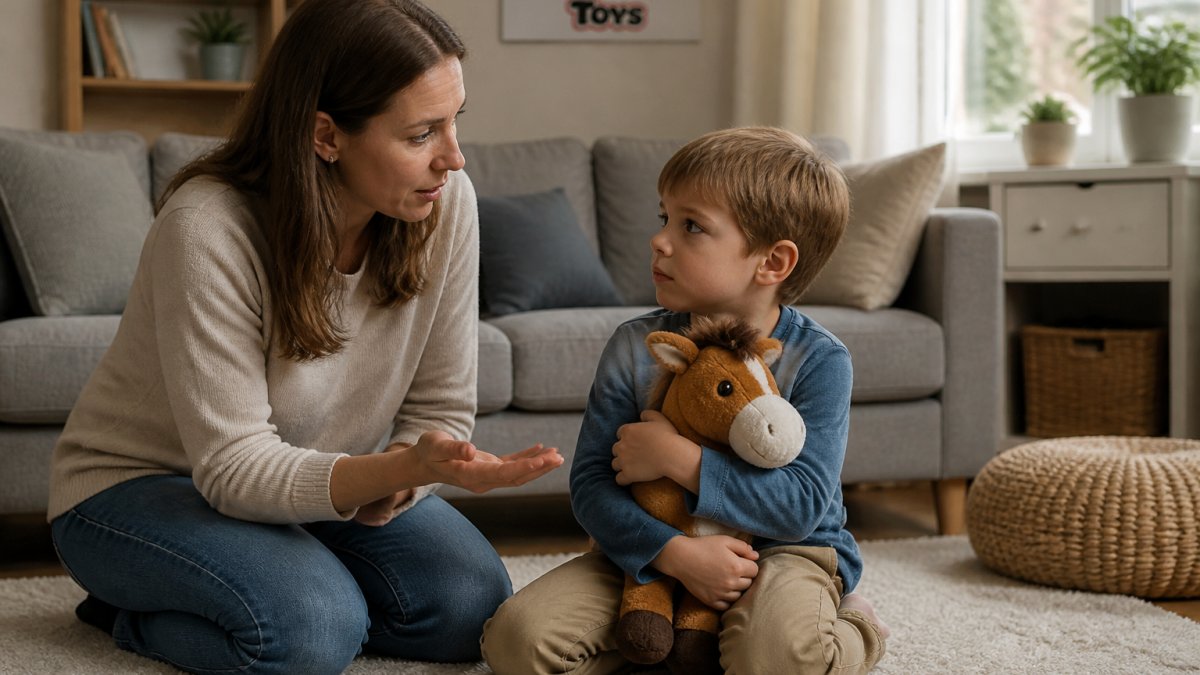
What that looks like in practice:
- Stay quiet and close. Fewer words, softer tone.
- Skip the consequences talk. Save it for later.
- Validate without agreeing. "You're really mad that we left the park" lands better than "Calm down."
A common mistake is correcting behavior in the middle of the storm. It feels urgent, but it rarely works.
When to Seek Professional Help for ADHD Emotional Regulation
Seek professional help when emotional dysregulation starts affecting daily life: school, friendships, sleep, or safety. Occasional big feelings are normal. A pattern that keeps a child from functioning is a signal to bring in someone trained to help.
Signs it is time to talk to a professional:
- Outbursts that cause injury to the child or others
- Meltdowns that last longer than thirty minutes most days
- Trouble at school that shows up in reports or discipline notes
Start with your pediatrician. From there, a child therapist or behavioral specialist can assess what is happening and whether other conditions are involved.
Why the overlap with other conditions matters
ADHD rarely travels alone, and the most common look-alikes change what treatment should focus on. A clinician will typically sort through these before settling on a plan:
- Anxiety: worry-driven reactions that build before an event rather than erupting in the moment; often worse with anticipation and better with avoidance.
- Depression: irritability and withdrawal that persist for weeks rather than tracking a trigger, often with sleep and appetite changes.
- Trauma: reactions tied to specific reminders, with hypervigilance or shutdown that does not follow the usual ADHD pattern.
This is why self-diagnosis from a checklist is unreliable. The same behavior can point to several different underlying causes, and the right support depends on which one is driving it. A qualified assessment is the only way to tell them apart with confidence.
What the research does and does not establish
Emotional dysregulation is well documented as a common feature of ADHD in both children and adults, and it is increasingly treated as a target for intervention rather than a side effect (pubmed.ncbi.nlm.nih.gov). What the evidence does not support is treating it as a core diagnostic criterion in every framework; the DSM-5-TR lists it under associated features, not as a required symptom.
How to track progress once you have help
A simple log beats memory. Note the trigger, the intensity (1-5), how long the episode lasted, and what helped. Review it weekly with your clinician or therapist. Three signals suggest the plan is working: episodes become less frequent, recovery time shortens, and your child starts using a coping skill without prompting. If none of those move after several weeks of consistent practice, that is useful information to bring back to the professional rather than a reason to push harder on your own.
For families supporting a child with autism alongside regulation differences, our article on teaching emotional regulation to autistic children covers co-regulation and sensory tools in more depth.
Build a Daily Regulation Routine with Bene World Toys
A daily regulation routine beats any single technique, because emotional regulation is a habit, not an event.
Here's the routine we recommend to families:
- Morning: name the day's expected feelings during breakfast
- After school: five minutes of movement, then a check-in
- Dinner: one gratitude or kindness moment
This is where our plush companions fit in. Haylo the Horse gives a child something to hold during big feelings, and a token system that rewards the practice of calming down and naming emotions.

If reward systems have burned you before, read why traditional reward charts fail kids. The short version: charts reward outcomes, and regulation needs to reward the effort.
Frequently Asked Questions
What does emotional dysregulation look like in a child with ADHD?
It often shows up as reactions that seem out of proportion to the trigger: sudden tears over a small change, shouting when asked to switch tasks, or a meltdown that lasts longer than expected. Children may struggle to name what they feel, calm down once upset, or return to baseline after a frustration. These signs of emotional dysregulation in children tend to cluster around transitions, hunger, fatigue, and overstimulation, which is why tracking patterns helps parents spot triggers before they pile up.
How can children with ADHD learn to calm down?
Calming techniques for children with ADHD work best when practiced during calm moments, not mid-meltdown. Try short daily rehearsals of belly breathing, squeezing a plush toy, or counting to five before responding. Keep the routine predictable and pair it with a tangible reward, like placing a token in a pouch after a successful calm-down. Over time, the body learns the sequence and can access it faster when stress rises, which builds the self-regulation muscle gradually.
What can parents do during an ADHD meltdown in children?
Lower your voice, reduce sensory input, and stay nearby without arguing or lecturing. Name the feeling briefly, then wait. Avoid reasoning until the storm passes, because the thinking brain is offline during intense emotional outbursts. Once your child is calm, revisit what happened and practice a calming technique together. A consistent comfort object, such as a plush companion, can become a reliable anchor that signals safety and helps shorten recovery time.
When should a parent seek professional help for emotional dysregulation?
Consider professional support when outbursts happen daily, last more than 20 to 30 minutes, cause injury or property damage, or interfere with school and friendships. Also seek help if your child seems hopeless, withdrawn, or unable to recover between episodes. A pediatrician, child therapist, or school counselor can assess whether ADHD emotional regulation challenges need therapy, behavioral parent training, or a treatment plan, and can rule out related conditions that mimic dysregulation.
Big feelings don't have to run your household. Bene World Toys builds plush companions and story-led kits that turn emotional regulation into a daily habit, with a token-based reward system, magnetic tail connections for tactile reinforcement, and write-in pages that start real conversations. Get started with Bene World Toys and give your child a calm-down routine that actually sticks.