


Last Updated: October 29, 2026
Quick Summary
Yes, positive reinforcement works for defiant behavior when parents add something a child wants after a wanted behavior so it repeats. It works best with specific, immediate praise or tokens paired with calm limits, and it works far better when you lower sensory overload first and reinforce the recovery.
- Positive reinforcement adds a reward after good behavior; punishment adds a consequence and rarely teaches a replacement skill.
- Expect an extinction burst: the behavior gets worse for a rough week or two before the old pattern breaks.
- Name the specific behavior and reward within seconds, since delayed praise loses its power for young kids.
- Match reinforcement to age: immediate tokens and hugs for ages 3-4, choice in rewards for ages 7-8.
- Start a token system with one behavior, one reward, and one reachable token count, then review weekly.
Table of Contents
- What Positive Reinforcement Actually Means for Defiant Kids
- Why Punishment-Based Approaches Backfire With Defiance
- Reward Systems for Kids That Actually Work
- Positive Reinforcement Strategies for Defiance That Hold Up Under Pressure
- How to Handle Defiant Behavior in Children: A Step-by-Step Approach
- The Sensory and Emotional Side of Defiance
- Parental Burnout: Regulating Yourself First
- Building a Token System That Fits Your Family
- Frequently Asked Questions
What Positive Reinforcement Actually Means for Defiant Kids
Does positive reinforcement work for defiant behavior? Yes, it does, but only when parents understand what reinforcement actually is.
The key word is adding. You add praise, attention, or a token. You do not take anything away.
This matters because defiance is rarely about a child wanting to be difficult. It is often about a child feeling powerless, overwhelmed, or unsure how to express a need.
- Positive reinforcement: adding a reward after good behavior
- Negative reinforcement: removing something unpleasant after good behavior
- Punishment: adding something unpleasant after bad behavior
Only the first one builds skills over time.
Positive Reinforcement vs. Positive Punishment
These two sound similar and behave nothing alike. Positive punishment adds a consequence, like extra chores or a sharp reprimand, after misbehavior. It stops a behavior in the moment.
Positive reinforcement does the opposite. It names the behavior you want and rewards it.
The American Academy of Pediatrics guidance on effective discipline points parents toward teaching and rewarding wanted behavior rather than relying on punishment alone. That is the core shift.
Why Punishment-Based Approaches Backfire With Defiance
Punishment-based approaches backfire with defiant children because they feed the exact cycle parents want to break. A child who feels controlled pushes back harder. The adult escalates. The child escalates.
Here is what most guides miss: defiance is often a stress response, not a character flaw. When a child is flooded with big feelings, the thinking part of the brain goes quiet.
Common mistakes we see parents make:
- Reacting in the heat of the moment instead of waiting for calm
- Using the same consequence for every behavior, so nothing teaches
- Focusing only on what went wrong and never naming what went right
If reward charts have already failed in your home, that is worth understanding before you try again. Our guide on why traditional reward charts fail kids explains the compliance trap and what to build instead.
Reward Systems for Kids That Actually Work
Reward systems for kids that actually work share three traits: they are simple, they are immediate, and they reward the behavior you can actually see. A system a child cannot understand by age five is a system that will not last.
Token systems fit this well. A child earns a token the moment a wanted behavior happens, then trades tokens for a reward the family agrees on.
Why token systems hold up better than sticker charts:
- They give immediate feedback, so the lesson lands while the moment is fresh
- They make progress visible, which motivates kids who need to see results
- They flex with your family, so you can target the behavior you are working on now
If you want the full picture of how token systems support young children, our breakdown of the benefits of token systems for toddlers covers the mechanics and the long-term payoff.
The Extinction Burst: What to Expect When You Switch Tactics
When you stop responding to a behavior the old way, it usually gets worse before it gets better. This is called an extinction burst.
This is not failure. It is a sign the old pattern is breaking.
Expect a rough week or two. Hold the line, stay warm, and keep rewarding the behavior you want. The burst fades when the child learns the old tactic no longer works.
Positive Reinforcement Strategies for Defiance That Hold Up Under Pressure
Positive reinforcement strategies for defiance work best when they are specific, fast, and delivered without a lecture. Consistent application of these techniques requires a structured approach, which is why integrating parenting workbook strategies helps parents maintain the necessary focus during moments of high defiance.
Try these:
- Name the behavior. "You put your shoes on the first time I asked."
- Reward within seconds. Delayed praise loses its power for young kids.
- Keep it small. A token, a high-five, a sticky note.
- Reward the attempt. A child who tries to calm down and partially succeeds still deserves credit.
- Stay neutral during pushback. Fewer words, calmer voice, same limit.
A common mistake is rewarding the outcome instead of the effort. A child who stays calm through a hard transition has done real work, even if the transition was still bumpy.
What Would You Do? Situational Card Game →
How to Handle Defiant Behavior in Children: A Step-by-Step Approach
Handling defiant behavior in children starts with regulating yourself before you regulate the child. A calm adult is the most effective tool in the room. Here is the sequence we recommend to families.
- Pause and lower your voice. Two seconds of silence beats a raised one.
- Name the feeling without judging it. "You're frustrated that screen time is over."
- Hold the limit. The rule stays. Only the tone softens.
- Offer two acceptable choices. "You can walk to bed or I can carry you. Which one?"
- Reward the recovery. The moment your child calms or complies, name it and reinforce it.
- Debrief later, not during. Talk through what happened once everyone is calm.
That last step is where real skill development happens. A child who reviews a hard moment with a calm adult learns to recognize the antecedent next time.
Age-Appropriate Reinforcement From Ages 3 to 8
What works at three falls flat at eight. Match the reinforcement to the developmental stage.
| Age | What Works | What to Skip |
|---|---|---|
| 3-4 | Immediate tokens, hugs, naming feelings | Delayed rewards, complex charts |
| 5-6 | Token systems with a visible goal | Long explanations during a meltdown |
| 7-8 | Choice in rewards, earning toward bigger goals | Babyish prizes, vague praise |
For a child with autism or sensory sensitivities, the same principles apply with more structure. Keep routines predictable, keep the token tactile, and keep the reward close to the behavior.
The Sensory and Emotional Side of Defiance
Some defiance is sensory, not behavioral. A child who melts down at a noisy store or a scratchy shirt is not testing you. Their nervous system is overloaded, and the behavior is the only exit they have. This is the piece most behavior guides skip, and it is often the reason a reward system that works at home fails in public.
How Sensory Overload Turns Into Defiance
Sensory processing is how the brain takes in and organizes sound, sight, touch, taste, and movement. When a child's system is flooded, a crowded aisle, a flickering light, a tag scratching the neck, the brain spends its energy managing the input.
Watch for patterns. Does defiance spike at certain times, in certain places, or around certain textures and sounds? Those clues point to behavioral triggers you can plan around.
Pairing Reinforcement With Sensory Regulation
Positive reinforcement still works for sensory-driven defiance, but it works far better when it is paired with regulation. Rewarding a child for calming down in a flooded environment is like rewarding someone for holding their breath underwater, the skill is real, but the setting makes it nearly impossible. Lower the sensory load first, then reinforce the recovery.
Proactive strategies help here:
- Warn before transitions so the child can prepare, and give a two-minute and a one-minute heads-up.
- Build a calming space with soft items, low light, and a predictable routine the child can retreat to.
- Reduce demands during high-stress moments. Fewer words, fewer choices, fewer instructions.
When the Root Is Emotional Regulation, Not Behavior
When the root is emotional regulation, the fix is skill-building, not punishment. A child who has never been taught to notice rising tension cannot be expected to manage it on command. Practice regulation skills during calm moments, naming feelings, slow breathing, a body check-in, so the skill is available when the storm hits. Our parent's guide on how to teach kids emotional regulation walks through the daily practices that make a difference.
Parental Burnout: Regulating Yourself First
You cannot co-regulate a child when your own tank is empty. Parental burnout is real, and it quietly undermines every strategy on this page.
Start with small habits. Three daily moments of connection do more than one grand gesture.
- A two-minute check-in at pickup or after school
- One shared activity with no screens and no agenda
- A calm bedtime ritual you both can count on
These habits rebuild the connection that makes reinforcement land. A child who feels connected wants to cooperate. A child who feels disconnected fights for control.
If connection has slipped in your home, our guide on how to build connection with children covers three daily habits that support regulation and social emotional learning.
Building a Token System That Fits Your Family
A token system only works if it fits your real life. Start with one behavior, one reward, and one clear number.
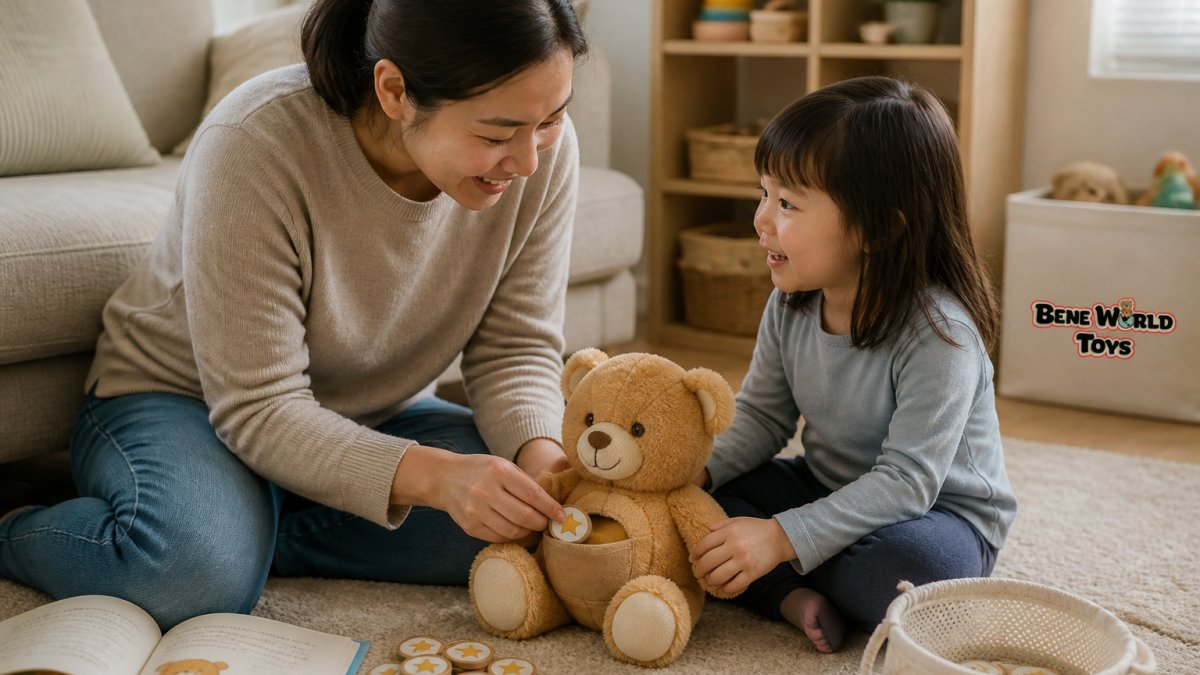
Here is how we would set it up:
- Pick one target behavior. Listening the first time, gentle hands, or kind words.
- Decide the token count. Keep it reachable within a week or two.
- Choose the reward together. Let the child have a say.
This is where our kits come in. And if you want the whole set, the My Reward Pal™ Collection bundles all four kits.

One honest limitation: a token system still requires you to be consistent. The kit makes the routine tangible and fun, but the follow-through is yours.
Frequently Asked Questions
How can positive reinforcement help reduce defiant behavior in children?
Positive reinforcement works by rewarding the behaviors you want to see more of, like calm words or following through on a request. Over time, children learn that cooperation earns attention and privileges, while defiance earns neither. Consistent, immediate feedback on desirable behaviors is a widely used approach in behavior support. The key is picking specific behaviors, such as gentle hands or using a calm voice, and reinforcing them right away rather than waiting until the end of the day.
What are some examples of positive reinforcement for defiance?
Practical examples include earning a token for using words instead of yelling, getting a sticker for transitioning to bedtime without a fight, or a high-five and specific praise when your child calms down after a tantrum. A token-based system works well because it makes the reward visible and repeatable. You can choose the behaviors you are working on right now, such as listening the first time or helping a sibling, and let your child collect tokens toward a reward you set together.
How do you use positive reinforcement without bribing a child?
A bribe is offered in the middle of a conflict to stop behavior, while reinforcement is set up in advance to encourage behavior you want. The difference is timing and predictability. Announce the system when everyone is calm, name the specific behaviors, and stay consistent. Avoid offering rewards as a negotiation during a meltdown. When children know what earns a token before the moment arrives, they learn to manage their own choices rather than bargaining in the heat of the moment.
Is positive reinforcement effective for children with oppositional defiant disorder?
Yes, with adjustments. A child's pediatrician or therapist can advise on which approach fits a child with oppositional defiant disorder. If defiance is severe or persistent, work alongside a pediatrician or childhood therapist who can tailor a behavioral intervention to your child.
Defiance is exhausting, and the old playbook of threats and consequences leaves everyone drained. Positive reinforcement offers a different path: name what you want, reward it fast, and stay steady through the rough patch. Bene World Toys builds the tools that make that routine stick, from the token-based reward system and magnetic tail connection to the write-in pages that spark real conversations. Get started with Bene World Toys and turn small daily wins into lasting positive behavior.