


Table of Contents
- What Social Emotional Learning Looks Like in a Real Classroom
- How to Implement SEL in the Classroom: A 4-Step Framework
- SEL Activities for Elementary Students That Take Under 15 Minutes
- SEL Classroom Management Strategies That Reduce Escalation
- Conflict Resolution Scripts You Can Teach This Week
- Adapting SEL for Neurodivergent Students
- How to Measure SEL Progress Without Formal Testing
- Frequently Asked Questions
Last Updated: October 1, 2026
What Social Emotional Learning Looks Like in a Real Classroom
Social emotional learning is how children learn to recognize and manage emotions, show empathy, and make responsible decisions. In a classroom it rarely looks like a separate lesson, it looks like a teacher naming a feeling out loud, a child using a calm-down corner unprompted, and a group resolving a disagreement over a toy.
The Five Core Competencies at a Glance
The five competencies are self-awareness, self-management, social awareness, relationship skills, and responsible decision-making. They overlap constantly: a student who notices frustration building (self-awareness) and chooses a breathing strategy (self-management) is using two at once.
| Competency | What It Looks Like | Quick Classroom Cue |
|---|---|---|
| Self-awareness | Naming feelings accurately | "I notice your hands are tight." |
| Self-management | Pausing before reacting | "Take three breaths with me." |
| Social awareness | Reading others' cues | "How do you think she felt?" |
| Relationship skills | Repairing after conflict | "What could you say next time?" |
| Responsible decision-making | Weighing consequences | "What are your two choices?" |
How to Implement SEL in the Classroom: A 4-Step Framework
Implementation works best when it is small, daily, and embedded in routines you already have, teachers who add a standalone SEL block often drop it by October. These four steps fold the work into what you already do.
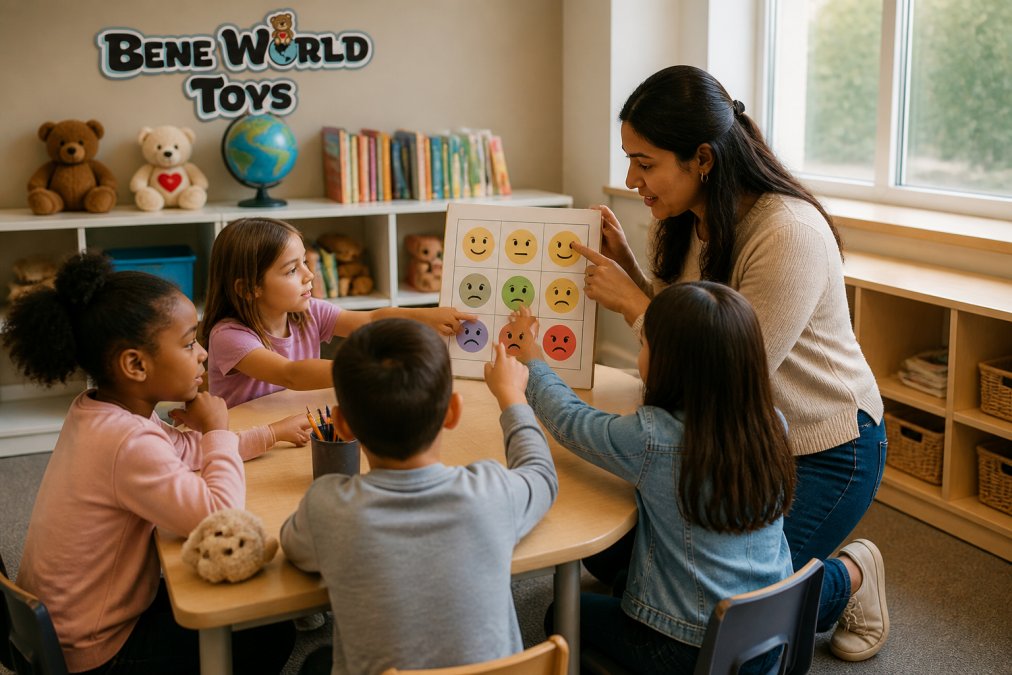
Step 1: Start With a 10-Minute Daily Check-In
A daily check-in gives every student a low-stakes way to name how they are arriving. Use a simple scale, a feelings chart, or a quick turn-and-talk. The goal is consistency, not depth. Ten minutes at the start of the day prevents far more disruption than ten minutes of correction later.
Step 2: Weave SEL Into Existing Lessons
You do not need new curriculum. Ask one reflection question after a read-aloud: "What would you have done differently?" During group work, name the relationship skill you want to see: "This station is practicing taking turns." SEL works when it rides on top of content you already teach.
Step 3: Teach and Practice the Language
Children cannot use a skill they have no words for. Teach feeling words, repair phrases, and calm-down requests like vocabulary, introduce, model, practice, review, and post them where students can see them. Consistent verbal scaffolding provides the structure necessary for keeping children engaged in meaningful social interactions throughout the school day, fostering a classroom environment that thrives on connection rather than digital distraction.
Step 4: Reinforce Consistently
Skills stick when they are noticed. A simple token or recognition system, where students earn credit for practicing a specific behavior, makes the skill visible and repeatable, the point is repetition, not the reward.
SEL Activities for Elementary Students That Take Under 15 Minutes
Short, repeatable activities beat long ones because they actually get done. None require prep beyond a quick read-through.
- Feelings check-in (5 minutes): Students point to a face or color that matches how they feel.
- Two-word weather report (3 minutes): "Sunny but windy" gives a safe way to share a mood.
- Role-play a conflict (10 minutes): Act out a common disagreement, then replay it with a better ending.
- Gratitude round (5 minutes): Each student names one thing that went well.
- Calm-down corner reset (5 minutes): Practice using the space before anyone needs it.
- Compliment pass (5 minutes): Students name something specific a classmate did well.
SEL Classroom Management Strategies That Reduce Escalation
Most escalations follow a predictable curve, and the goal is to interrupt it early rather than win the moment. SEL classroom management strategies focus on de-escalation before correction: at the peak of a meltdown, reasoning does not work, but regulation does.
Read the Stage Before You Respond
Behavior escalates in stages, and the right move changes at each one:
| Stage | What You See | What Helps | What Backfires |
|---|---|---|---|
| Early trigger | Fidgeting, withdrawal, sharp tone | Proximity, quiet redirection | Calling attention to the behavior publicly |
| Agitation | Refusal, muttering, pushing materials | Offering a two-option choice | Issuing an ultimatum |
| Peak | Yelling, crying, leaving the seat | Few words, space, safety | Reasoning, lecturing, consequences |
| Recovery | Slumped shoulders, deep breaths | Quiet presence, water, time | Rehashing the incident immediately |
| Reflection | Calm, willing to talk | Repair conversation, next-time plan | Skipping the repair entirely |
The 90-Second Regulation Window
Regulation is faster than reasoning. At the peak, useful moves are physical and brief:
- Lower your voice instead of raising it. A quieter tone pulls attention toward you.
- Drop to the student's eye level rather than standing over them.
- Offer a choice between two acceptable options: "Do you want to take a walk to the fountain or sit in the calm-down corner for two minutes?" Choice restores a sense of control, which is usually what the escalation is about.
- Use one sentence, not five. "You look really frustrated right now" lands; a paragraph does not.
- Give space. Standing within arm's reach during a peak often prolongs it.
Scripts for the Early Stages
These lines name the emotion without judgment and hand control back to the student:
- "I can see something is off. Do you want to talk now or after the next station?"
- "Your hands are tight. Let's take three breaths together before we keep going."
- "I'm not asking you to be fine. I'm asking you to stay in the room while you're not fine."
- "You have two choices, and both are okay with me."
After the Peak: The Repair Conversation
Save the consequences conversation for later, once the student is calm. The repair conversation follows four moves:
- Name what happened without blame: "You threw the marker and left the group."
- Ask for the student's version: "What was going on for you?"
- Connect to the skill: "Which of our calm-down strategies could you try next time?"
- Agree on the next step: "So next time you feel that build-up, you'll ask for the corner. Deal?"
Never introduce a new SEL skill, script, or consequence in the middle of a peak. New language cannot be absorbed while a student is dysregulated. Teach it during calm moments and practice it there.
What to Avoid
- Public correction. It usually escalates rather than resolves.
- Sarcasm or rhetorical questions like "Why would you do that?" They read as attacks.
- Promising a consequence you cannot or will not deliver.
- Treating every escalation as a discipline problem when it may be a sensory, hunger, or sleep problem.
When to Bring in More Support
Classroom strategies have limits. Loop in a school counselor, school psychologist, or administrator when escalations are frequent, unsafe, or resistant to every regulation tool you have tried, that is not a failure of your SEL practice, but the correct use of your team.
Conflict Resolution Scripts You Can Teach This Week
Most SEL guides tell teachers to "teach conflict resolution" without showing the words. Scripts remove the need to invent the right sentence in a heated moment, for students and for you. Below are the exact lines to teach, teacher-side scripts, and a practice routine that builds muscle memory before anyone needs it.
What Would You Do? Situational Card Game →
The Student Script: Four Steps
Teach these four lines as a sequence, and post them where students can see them:
- "I feel ___ when you ___."
- "I need ___."
- "What do you need?"
- "What can we try next time?"
Teacher-Side Scripts for Running the Conversation
When two students are in front of you, keep the script moving without taking it over:
- Opening: "We're not here to decide who's in trouble. We're here to figure out what happens next time."
- Redirecting blame: "I hear what they did. Tell me your part first."
- When one student dominates: "Hold that thought. I want to hear from the other person before we come back to you."
- When a student says "I don't know": "That's okay. Take a breath. What was happening right before it got loud?"
- Closing: "So next time this starts, what's the first thing each of you will do?"
Age Adaptations
- Grades K-2: Shrink the script to three lines, "I feel ___. I need ___. Can we try ___?" Use picture cards for the feeling and the need. Expect to model it every time for the first several weeks.
- Grades 3-5: Use the full four-step script. Add a written version so students who freeze verbally can fill in the blanks on paper and hand it over.
- Grades 6-8: Keep the four steps but drop the worksheet. Middle schoolers respond better to a private two-minute conversation than a public mediation.
- Grades 9-12: Frame the script as a life skill, not a classroom rule. Many students will use the same four lines with friends, coworkers, and family.
Practice Routine That Makes It Stick
A common mistake is introducing a script mid-argument, when no one can absorb new language. Instead:
- Week 1: Model the script yourself, out loud, using a low-stakes example (a borrowed pencil, a lost turn).
- Week 2: Role-play one scripted conflict as a whole class, then in pairs. Use a familiar scenario, not a real one.
- Week 3: Add a "replay" round, act out the same conflict with a worse ending, then a better one. Naming the difference is what teaches the skill.
- Ongoing: Keep the four lines posted. When a real conflict happens, point to the poster and ask the student which line comes next.
The Repair Follow-Up
Resolution is not the same as repair. After the script, ask each student: "What's one thing you'll do to make this right?" The answer can be small, a returned item, an apology, an offer to sit together at lunch, but the student, not the teacher, names the repair.
Practice the script during calm moments, not during conflict. A script rehearsed on a Tuesday morning is available on a Thursday afternoon.
When the Script Is Not Enough
Scripts handle everyday peer conflict. They are not a substitute for intervention when there is bullying, a power imbalance, or a safety concern. In those cases, follow your school's reporting process and bring in a counselor or administrator rather than running peer mediation.
Adapting SEL for Neurodivergent Students
Standard SEL lessons assume students can read facial expressions, tolerate group discussion, and interpret abstract language. Many neurodivergent students cannot do all three, and the fix is adaptation, not exclusion. Make feelings concrete with visuals and scales instead of "how do you feel?" Keep routines predictable, allow alternative responses like pointing or writing, and keep sensory needs in mind: a calm-down corner with soft textures and low light beats a busy one.
How to Measure SEL Progress Without Formal Testing
You can track growth without a single quiz. Measuring SEL progress means watching for behavior changes over time, not scoring a student on a scale. Use a simple observation log: note one specific behavior, the context, and what happened. Look for trends across weeks, not single incidents.
Three practical measures:
- Frequency counts: How often does a student use a calm-down strategy unprompted?
- Time to recover: How long does it take to return to baseline after a upset?
- Repair attempts: Does the student initiate an apology or a fix?
Frequently Asked Questions
What are some examples of social-emotional learning activities for teachers?
Common examples include a daily feelings check-in where students name their emotion, role-play cards that present a situation and ask 'What would you do?', gratitude circles at the end of the day, and calm-down corners with breathing prompts. Card games like What Would You Do? Situational Card Game give students 60 scenarios to practice positive choices and earn points, which keeps the activity structured and repeatable. Most of these take 10 to 15 minutes and fit into morning meeting or transition time.
How do I teach social emotional learning in the classroom without adding to my schedule?
Attach SEL to routines you already run. Use attendance as a feelings check-in, turn read-aloud time into a discussion about how a character handled conflict, and use transition minutes for a breathing exercise. When you implement SEL this way, it becomes part of the instructional tone rather than a separate subject. Teachers who embed it in existing lessons report it takes less time than standalone SEL blocks and reinforces the same competencies, including self-awareness and responsible decision-making.
How does social emotional learning improve student academic outcomes?
SEL builds the conditions learning requires: emotional regulation, attention, and positive relationships with peers and teachers. When students can manage frustration and resolve conflicts, less instructional time is lost to disruptions. Growth mindset and self-management skills also help students persist through difficult work. Research on evidence-based SEL programs consistently links them to improved behavioral frameworks in class, stronger teacher-student rapport, and better student engagement, all of which support academic performance over time.
What are the five core competencies of SEL?
The five competencies are self-awareness, self-management, social awareness, relationship-building, and responsible decision-making. Self-awareness means naming feelings and strengths. Self-management covers emotional regulation and impulse control. Social awareness is empathy and perspective-taking. Relationship-building includes communication and conflict resolution. Responsible decision-making means evaluating consequences before acting. Most classroom activities target one or two at a time, and a token reward system can reinforce all five by making prosocial behavior visible and repeatable.
Can SEL strategies work for neurodivergent students or students with sensory sensitivities?
Yes, with adjustments. Keep routines predictable, use concrete visual supports instead of abstract language, and allow quiet alternatives to group sharing. Soft plush tools like Haylo the Horse give students a tactile way to practice calming and naming feelings without pressure, and the token system lets you reinforce small, specific behaviors. Avoid forcing eye contact or verbal participation. The goal is the same skill set, delivered at a pace and intensity the student can tolerate.
How do I know if SEL is actually working in my classroom?
Track observable behavior rather than test scores. Note how often you redirect the same students, how quickly conflicts de-escalate, and whether students use feeling words without prompting. Simple tallies on a clipboard, plus brief student self-assessments using a faces scale, give you data over four to six weeks. You can also measure SEL progress by counting how many students independently use a conflict resolution script or calm-down strategy. Small shifts in these patterns show the skills are transferring.
Behavior escalates when students lack the words and routines to handle big feelings, and that gap shows up in every classroom. Bene World Toys builds plush companions and storybooks with a token-based reward system, a magnetic tail connection for tactile reinforcement, and write-in pages that spark real conversation between adults and children. Get started with Bene World Toys and turn emotional regulation into a daily habit your students can actually repeat.