


Table of Contents
- What You'll Need Before You Start
- Step 1: Name Emotions Out Loud Every Day
- Step 2: Use Empathy Activities for Preschoolers That Fit Your Routine
- Step 3: Build Emotional Regulation for Preschoolers During Big Feelings
- Step 4: Model Empathy in Action, Not Just Words
- Step 5: Use Bene Tails Plush Toys to Make Empathy Tangible
- Step 6: How to Teach Kindness to Toddlers Alongside Empathy
- Step 7: Adapt Your Approach for Neurodivergent Kids and Digital Life
- Frequently Asked Questions
Last Updated: September 10, 2026
What You'll Need Before You Start
When you teach empathy to preschoolers, it works best as a daily habit rather than a single lesson. At Bene World Toys, children absorb kindness fastest when it's practiced in small, repeatable moments, not explained once and forgotten.
Here's what to have ready before you begin:
- A calm, predictable routine you can attach new habits to
- One or two plush companions your child can hold and talk to
- A short list of the specific behaviors you want to reinforce
- Patience for repetition, because preschoolers need many exposures before a behavior sticks
The steps below take about ten minutes a day. That's it. Consistency matters far more than duration.
Step 1: Name Emotions Out Loud Every Day
The fastest way to build emotional vocabulary is to narrate feelings as they happen. Say "I'm frustrated that the lid won't open" or "You look disappointed the park is closed." A common mistake is waiting for a meltdown to introduce feeling words. By then, a preschooler's thinking brain is offline.
Label emotions during calm moments too. Point out a happy dog, a worried character in a book, a proud sibling. Children who hear feeling words often are better at recognizing them in themselves, which is the foundation of perspective-taking.
Step 2: Use Empathy Activities for Preschoolers That Fit Your Routine
The best empathy activities for preschoolers are the ones that slot into what you already do, not a separate curriculum you have to schedule. Two formats work especially well.
Pretend Play and Role-Playing Scenarios
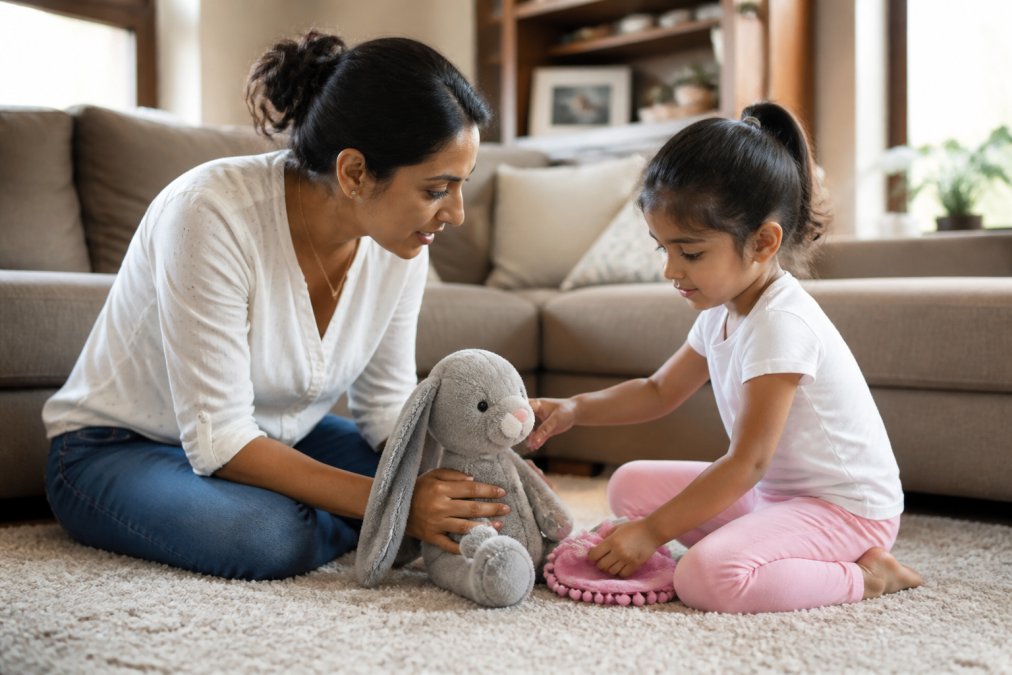
Pretend play lets a child try on someone else's feelings safely. Hand a plush toy a problem: the toy is left out of a game, or drops its snack. Ask your child what the toy might be feeling and what would help. This is perspective-taking in its simplest form.
Books and Story Time That Build Perspective
During story time, pause and ask how a character feels and why. The American Academy of Pediatrics guidance on reading with children notes that shared reading supports language and social-emotional development at the same time. Keep the questions open, and let your child guess.
Step 3: Build Emotional Regulation for Preschoolers During Big Feelings
Emotional regulation for preschoolers develops through co-regulation first. A child learns to calm down by borrowing an adult's calm, not by being told to calm down.
When big feelings hit, validate before you correct. "You're angry the tower fell. That's hard." Then offer a tool: deep breaths, a squeeze of a plush toy, a quiet corner. A common mistake is rushing to fix the problem before acknowledging the feeling. Fix the feeling first, then the problem.
Step 4: Model Empathy in Action, Not Just Words
Children copy what they see far more than what they hear, which is why the best way to teach empathy is to show it. Modeling behavior means showing empathy when it's inconvenient: when you're tired, when someone cuts you off, when your child spills juice for the third time.
Try narrating your empathy out loud. "That man looked upset. I wonder if he needs help." This makes an invisible mental process visible. What most guides miss is that modeling isn't about being perfect. It's about repairing well when you get it wrong.
Step 5: Use Bene Tails Plush Toys to Make Empathy Tangible
Abstract ideas like compassion become real for preschoolers when they can hold them. The Bene Tails collection pairs a plush companion with a story, so a child practices kindness, friendship, and caring for others through play rather than instruction.

The Friendship Tails Kit, featuring Pyro and Uniglo, turns "be a good friend" into clear actions: kind words, taking turns, including others. When your child shows one of those behaviors, they connect the magnetic tails, a tactile reinforcement that makes the moment stick. The Sparkle the Rescue Dog kit centers on caring for animals, while Bene Bear supports everyday good choices. engaging siblings of different ages.
This is the difference between telling a child to be kind and giving them something to do with that instruction.
Step 6: How to Teach Kindness to Toddlers Alongside Empathy
Knowing how to teach kindness to toddlers starts with making kindness concrete and small. Empathy is the feeling; kindness is the action that follows. Preschoolers need help connecting the two, because the gap between "I notice you're sad" and "here's what I'll do about it" is where most of the learning happens.
Why the Two Skills Diverge
A preschooler can recognize that a friend is crying and still walk away, not because they don't care, but because they don't yet have a bank of actions to draw from. Kindness is a skill built through repetition, the same way a child learns to hold a crayon. The goal is to make the next kind action obvious and easy.
Concrete Ways to Build the Kindness Habit
- Name the act, not the trait. "You shared your cracker. That was kind" teaches a repeatable behavior. "You're such a good boy" teaches a label the child can't recreate on demand.
- Give a specific job. Handing a sibling a toy, feeding a pet, or carrying a napkin to the table turns kindness into a task with a clear finish line.
- Use a two-step script. "She's sad. What could we do?" Then offer two choices: "Give her a hug, or bring her a toy?" Choice removes the freeze that stops many preschoolers from acting.
- Catch kindness in the wild. Point out kind acts you notice in others: "That man held the door for us. That was kind." Naming it in the world makes it visible at home.
- Keep a simple record. A sticker chart, a jar of pom-poms, or a magnetic tail connection gives kindness a visible tally. The record matters less than the ritual of adding to it together.
- Repair, don't shame. When kindness doesn't happen, and it won't, every day, skip the lecture. "That hurt him. What could we try next time?" keeps the door open.
Kindness and Empathy as a Loop
Kindness and empathy feed each other. When a child acts kindly and sees the other person light up, that reaction becomes data: "My action changed how someone felt." Over time, that loop builds the motivation to notice feelings in the first place. This is why the small, repeatable acts matter more than any single big gesture.
The national early learning guidance on social-emotional development consistently links early prosocial behavior to later social skills, which is why these small habits are worth the repetition.
Step 7: Adapt Your Approach for Neurodivergent Kids and Digital Life
Standard empathy advice assumes a neurotypical child, and that's a real gap. For neurodivergent kids, including children with autism, empathy is often present but expressed differently. Many parents and practitioners describe a pattern where a child feels deeply but doesn't read faces, tone, or unspoken social rules the way peers do. The fix isn't to push harder on abstract prompts like "think about how they feel." It's to make empathy concrete, visual, and predictable.
Concrete Strategies for Neurodivergent Preschoolers
- Use scripts, not hints. Instead of "be nice," give the exact words: "Can I play too?" or "That looks fun." Rehearse the line during calm play so it's ready when it's needed.
- Make feelings visual. A simple feelings chart with faces, colors, or a five-point scale lets a child point to a state instead of naming it on the spot. Many speech and occupational therapists use this kind of visual support because it lowers the language demand.
- Teach the body clues first. "Her arms are crossed and her voice got quiet, that can mean she's sad." Naming observable cues builds a bridge to the feeling underneath.
- Respect sensory limits. A child who is overwhelmed by noise, crowds, or tags has less capacity for perspective-taking in that moment. Regulate the environment before you teach the lesson.
- Skip forced eye contact. "Look at me" is not the same as listening. A child can show empathy while looking at the floor, a toy, or out a window.
- Reinforce the intent, not the polish. If your child hands a crying friend a toy without saying a word, that counts. Name it: "You saw she was sad and gave her something. That was kind."
A common mistake is treating a delayed or unusual empathy response as a deficit. In practice, many neurodivergent children show empathy through action, fixing a problem, fetching an adult, sharing a favorite object, rather than through facial expression or verbal comfort. Watch for the version your child offers, and build on it.
Digital Empathy for the Preschool Set
Preschoolers now video chat with grandparents, watch shows on tablets, and play simple games alongside siblings. That's a real social space, and it's rarely covered in empathy guides for this age. A few habits make it teachable:
- Narrate screen feelings. "Your cousin looked sad when you hung up. Should we call back and say goodbye?"
- Pause and ask. During a show, stop on a character's face: "Her eyebrows are down. What do you think happened?"
- Model your own screen behavior. Say "I'm putting my phone down so I can listen to you", that's empathy in action, and it's visible.
- Name the limits of screens. "We can't see if Grandma is smiling behind the phone. Let's ask her how she feels."
- Keep video calls short and warm. A two-minute call where your child says hello and waves goodbye teaches more than a twenty-minute call where they wander off.
The Common Sense Media research on young children and media offers practical framing for these conversations, and the American Academy of Pediatrics guidance on screen time and young children is a useful reference for how much screen time fits this age.
Frequently Asked Questions
How do I explain empathy to a 4-year-old?
Keep it concrete and tied to what they can see. Say something like, 'Empathy means noticing how someone feels and showing you care.' Use examples from their day: 'When your friend cried because she fell, you gave her your toy. That was empathy.' Pair the words with actions they already understand, like hugs, sharing, or gentle hands. Preschoolers learn best when the concept connects to a real moment they just experienced, not an abstract definition.
Is it normal for a 4-year-old to seem like they lack empathy?
Yes. Preschoolers are still developing perspective-taking skills, so they often focus on their own needs first. This is a developmental milestone, not a character flaw. Most children begin showing genuine empathy between ages 4 and 6 as their emotional vocabulary and social awareness grow. If your child rarely responds to others' feelings by age 6, talk with your pediatrician or a child development specialist for guidance.
What are some fun empathy activities for preschoolers?
Try feelings charades where kids act out emotions and others guess, or use situational card games that ask 'What would you do?' during pretend play. Reading books with characters who face challenges builds perspective-taking. You can also create a kindness jar where your child adds a token each time they notice someone needs help. Keep activities short, playful, and repeated often so empathy becomes a habit rather than a lesson.
Can plush toys and storybooks really help teach empathy?
Yes, when they are paired with adult guidance. Plush toys give children a tangible way to practice caring behaviors, like comforting a stuffed animal or connecting magnetic tails to show friendship. Storybooks introduce characters whose feelings kids can discuss. Research on social-emotional learning shows that combining role-play with stories helps children practice perspective shifting and emotional vocabulary in a low-pressure way.