


Table of Contents
- Why Manners Matter at Age Four
- Age-Appropriate Manners for Preschoolers
- Teaching Please and Thank You for Kids
- Teaching Table Manners to Young Children
- Model Polite Behavior Daily
- Manners Activities for Preschoolers
- When Your Child Refuses, Forgets, or Resists
- Build Manners Into Daily Routines
- Frequently Asked Questions
Last Updated: October 11, 2026
Why Manners Matter at Age Four
Teaching manners to 4 year olds is one of the most practical investments you can make in your child's social development. At this age, children are absorbing how to interact with others at lightning speed.
Here's what matters: four-year-olds are developmentally ready to understand cause and effect. When they say "please," people respond positively. When they grab without asking, they face a boundary. They're starting to care about how others perceive them. That's your window.
Manners aren't about rigid rules or forcing politeness. They're about giving your child tools to navigate the world with confidence and kindness. A child who knows how to ask nicely, listen when someone speaks, and say thank you is a child who gets along better with peers, teachers, and family.
Age-Appropriate Manners for Preschoolers
Not every politeness rule belongs at age four. Your job is to focus on what they can actually learn and master, not what will frustrate you both.
What Four-Year-Olds Can Actually Learn
Four-year-olds have the cognitive ability to learn and practice these core manners:
- Please, thank you, and you're welcome, These are the foundation. They're short, repeatable, and children this age can connect them to getting what they want.
- Saying excuse me, Useful in everyday moments (getting past someone, interrupting gently).
- Greeting people, "Hi," "hello," and looking at someone when they talk to you. Simple but powerful.
- Asking nicely instead of demanding, "Can I have..." instead of grabbing.
- Taking turns and waiting, This one takes practice, but four-year-olds are developmentally ready to understand it.
- Listening when others speak, Not perfectly, but they can practice making eye contact and not interrupting.
- Saying sorry and meaning it, Though genuine remorse develops over time, they can learn the words and the action of apologizing.
These manners work because they're concrete, immediate, and your child sees results. When they say please, good things happen. When they wait their turn, they get a turn. The cause and effect is clear.
What to Skip for Now
Don't waste energy on these yet. They're too abstract or require emotional development that comes later:
- Complex table manners (using the right fork, napkin placement, formal dining rules)
- Sitting still for long periods at formal events
- Understanding social hierarchy or when to use formal vs. casual speech
- Writing thank-you notes or understanding delayed gratitude
- Complex apologies that require understanding someone else's feelings deeply
You'll introduce these gradually as they get older. Right now, keep it simple.
Teaching Please and Thank You for Kids
These two words are your starting point. They're short enough for a four-year-old to remember, powerful enough to change how people respond to your child, and simple enough to practice daily.
Making the Words Stick
Repetition is your best tool. But not boring, mechanical repetition. Here's how to make it stick:
Model it constantly. Say please and thank you to your child, to other adults, to the cashier, to the dog. Let them hear it in natural conversation, not as a lesson. When your child sees you say "Thank you for helping me" to a family member, they're learning that gratitude is how we treat people we care about.
Practice it in real moments. When your child asks for juice, pause and wait. Don't say "What do you say?" in a stern voice, that triggers resistance. Instead, pause with a gentle smile. Most four-year-olds will catch on.
Make it rewarding. When teaching manners to 4 year olds, positive reinforcement works better than correction. Notice when they use please or thank you without prompting. "I noticed you said please without me asking. That was respectful." That acknowledgment is powerful.
Use a token system for consistency. Tools like Bene Bear® turn polite language into something tangible. Your child earns tokens when they practice please, thank you, or other respectful words. When they collect all 15 tokens, they redeem a reward you've set.
Teaching Table Manners to Young Children
Table manners are where teaching manners to 4 year olds gets real. Mealtimes happen multiple times a day, so you have built-in practice opportunities. Start small.
Start With One Habit at a Time
Don't try to fix everything at once. Pick one table manner and focus on it for two weeks. Then add another.
Week 1-2: Chewing with mouth closed. This is visible, easy to understand, and directly improves the mealtime experience for everyone. "Let's keep our food in our mouth while we chew." Model it.
Week 3-4: Using a napkin. Show them how to wipe their mouth.
Week 5+: Asking politely for things at the table. "May I have more milk?" instead of pointing or demanding. Use the same approach as teaching please and thank you.
Other age-appropriate table manners include sitting in their chair (mostly), not throwing food, and saying thank you for the meal. That's plenty for now.
Model Polite Behavior Daily
Your child learns manners by watching you, not by listening to your lectures. If you want them to say please and thank you, they need to hear you doing it, especially to them.
When you model polite behavior, you're showing your child that respect isn't something you demand from kids. It's how everyone in your family treats each other. Say please when you ask your child to do something.
This is harder than it sounds, especially on difficult days. But it's the most powerful teaching tool you have.
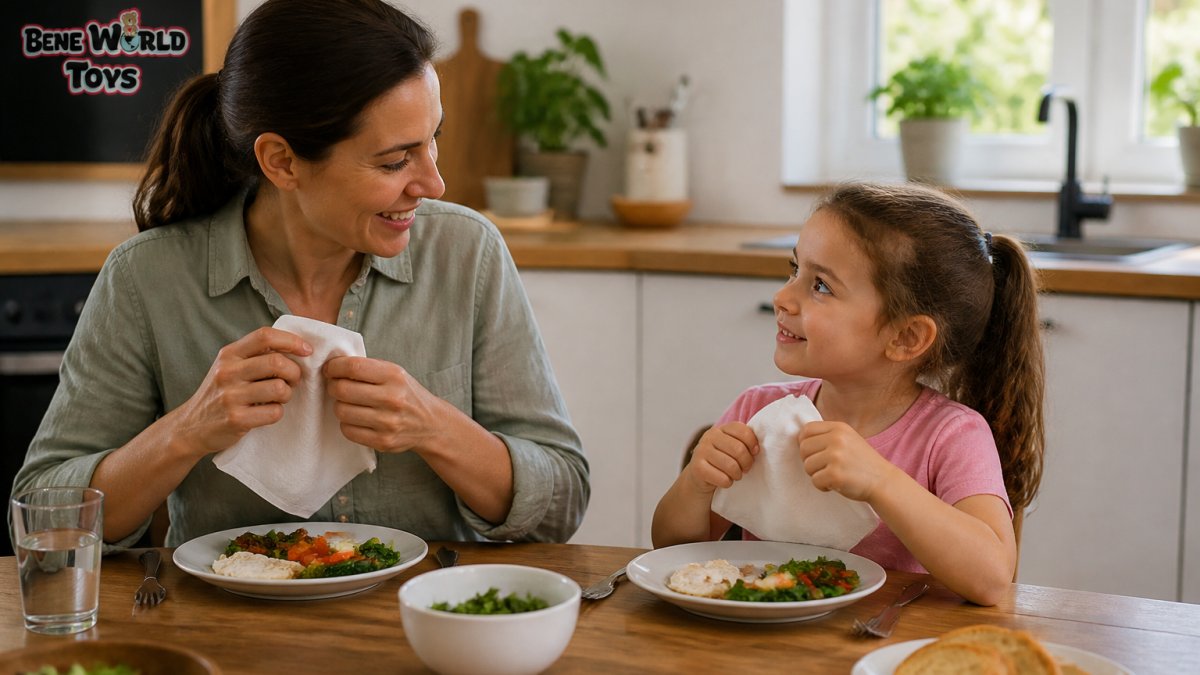
When you slip up, and you will, acknowledge it. "I spoke sharply just now. I'm sorry.
Manners Activities for Preschoolers
Practice works better when it doesn't feel like practice. Games, stories, and role-play turn manners into something your child wants to do.
Games and Role-Play Practice
Role-play real situations. Pretend you're going to a restaurant. One of you is the server, one is the customer. Practice ordering politely, saying thank you, and asking nicely for things. Switch roles. Four-year-olds love this because it feels like play.
Play the "What Would You Do?" game. Present simple social scenarios: "Your friend has a toy you want. What do you say?" Or: "Someone helps you pick up your toys. What do you say?" Let your child answer. Celebrate the respectful responses. This builds their ability to think through situations before they happen.
Use a card game designed for this. What Would You Do? Situational Card Game presents 60 scenarios where your child chooses the response that shows positive behavior. They earn points for kind choices. It's fun, and it's teaching.

Stories and Books That Teach Respect
Stories stick with four-year-olds in a way lectures never do. When a character in a book shows kindness or respect, your child connects emotionally to that behavior.
Read books that show characters practicing manners and respect. Look for stories where kindness has a real impact, where characters apologize and repair relationships, and where gratitude and empathy are shown in action, not just mentioned.
Pair stories with your own token system. Bene Bear® Benefits The World Storybook tells the story of Bene Bear practicing kindness, respect, empathy, and benevolence. When you read it together, your child sees what these values look like. Then, when they practice these behaviors in real life, they earn tokens. The story and the system work together.
When Your Child Refuses, Forgets, or Resists
Real life is messier than any guide. Your child will forget to say please. They'll refuse to say sorry. They'll test boundaries. This is normal development, not failure.
Gentle Reminders Without Shame
When your child forgets, a soft reminder works better than criticism. "I noticed you asked for the toy without saying please. Let's try again." Then give them the chance to redo it. This teaches the behavior without shame.
Some children respond well to a simple prompt: "What do you say?" Others need more support: "You want the marker. Can you ask nicely?" Adjust based on your child's temperament.
Never force an apology or a thank you. Forced politeness isn't genuine, and it teaches your child that manners are about performance, not respect. Instead, model what a real apology looks like: "I'm sorry I spoke harshly. I was frustrated, but that's not okay. I'll try to use kinder words."
Handling Inconsistency Without Power Struggles
Your four-year-old will use manners perfectly one day and completely ignore them the next. This isn't defiance. It's how young brains work. They're still building these habits.
Stay consistent on your end. Keep modeling. Keep noticing when they do use manners. Keep the practice light and positive. Don't shame them for forgetting.
If your child is resistant to the whole concept of manners, step back. You might be pushing too hard. Take a break for a week, then restart with a fresh approach. Sometimes children resist because they feel pressured. A lighter touch often works better.
Build Manners Into Daily Routines
Mealtimes: Practice please, thank you, and table manners during every meal. It's already happening, so use the time.
Greetings: When you pick up your child from preschool, have them greet their teacher. When someone visits, practice saying hello.
Transitions: Moving from one activity to another is a good time to practice asking nicely.
Bedtime routines: Thank your child for their help during the day. Model gratitude for the time together.
Playdates and group settings: Before you go, remind your child about taking turns and using kind words.
The more you weave manners into everyday moments, the more natural they become.
Teaching manners to 4 year olds doesn't require perfection.
At Bene World Toys, we've built tools specifically designed to make this easier.
Frequently Asked Questions
What manners are age-appropriate for a 4-year-old?
Four-year-olds can learn to say please, thank you, and excuse me with reminders. They can practice waiting their turn, listening when others speak, and using respectful language. Table manners like chewing with their mouth closed and using a napkin are realistic goals. Don't expect perfection, consistency and effort matter more. Greetings like saying hello and goodbye are also within reach. Skip complex etiquette; focus on kindness and basic respect instead.
How can I teach my 4-year-old to say please and thank you?
Model the words constantly in your own speech. When your child asks for something, pause and say, 'What's the magic word?' Remind gently, without frustration. Practice during everyday moments: meals, transitions, playtime. Use a reward system tied to consistent practice, tools like Bene Bear® ($34.99) turn saying please and thank you into a repeatable habit by letting children earn tokens for using polite words. Praise effort, not just success. It takes weeks of repetition before the words become automatic.
What should I do when my child refuses to use manners or forgets?
Stay calm and avoid power struggles. Gentle reminders work better than punishment. Say, 'I notice you asked without saying please. Let's try again,' and give your child a chance to correct themselves. Forgetting is normal at this age, their brains are still developing impulse control. Consistency across all caregivers matters; coordinate expectations with teachers, grandparents, and other adults in your child's life. If resistance is frequent, check whether you're asking for too much at once or if your child is tired, hungry, or overwhelmed.
How do I teach table manners without making mealtimes stressful?
Introduce one table manner at a time over weeks, not all at once. Start with sitting at the table during meals, then add chewing with mouth closed, then using a napkin. Model the behavior yourself so your child sees it in action. Keep reminders light and brief. Use stories or games to make it fun, books and activities that celebrate polite behavior help children internalize manners as kindness, not rules. Celebrate small wins. Avoid criticizing or shaming; focus on what they did well instead.